
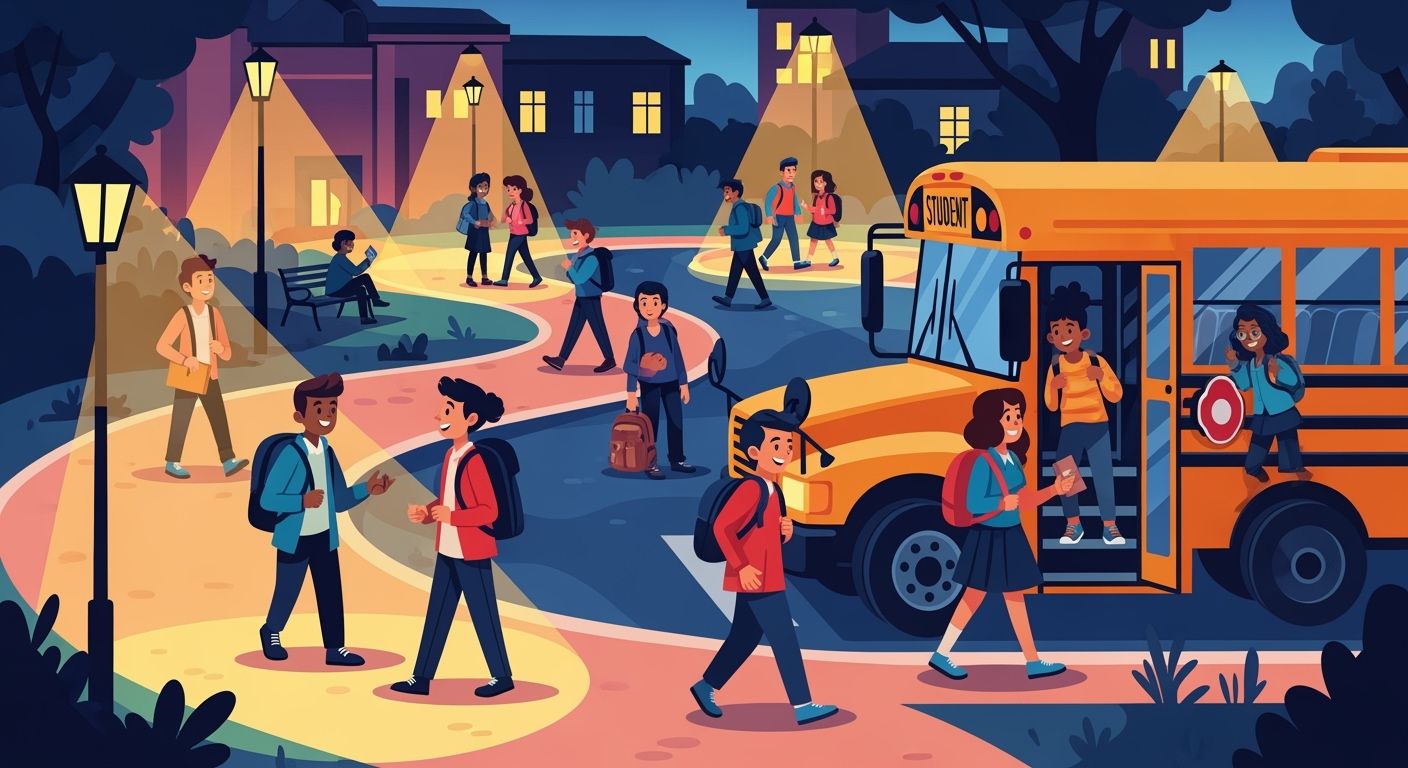
Outdoor lighting helps schools maintain visibility and security across campus roads, bus loops, drop-off and pick-up zones, pedestrian crossings, parking areas, walkways, and building entrances.
Modern LED street lights can reduce energy and maintenance requirements compared with older lighting technologies. However, project performance depends on more than fixture efficiency. Each campus zone has different traffic patterns, operating hours, pedestrian activity, glare risks, and security requirements.
For school authorities, engineering consultants, contractors, and municipal procurement teams, the lighting design should coordinate luminaires, poles, controls, CCTV coverage, signage, road markings, and pedestrian infrastructure. Final illumination levels and equipment configurations must be based on site-specific calculations and applicable local standards.
Key Takeaways
- Divide the campus into functional lighting zones rather than applying one fixture and pole configuration throughout the site.
- Prioritize bus loops, vehicle entrances, pedestrian crossings, drop-off areas, parking zones, and accessible routes.
- Control glare so lighting improves visibility without affecting drivers, nearby classrooms, residential properties, or surrounding roads.
- Use lighting calculations to determine luminaire optics, mounting heights, pole spacing, and required uniformity.
- Coordinate lighting controls with school operating hours, security procedures, CCTV systems, and after-hours activities.
- Evaluate pole locations against pedestrian circulation, buried utilities, landscaping, vehicle clearances, and maintenance access.
- Compare lifecycle cost, warranty, replacement parts, controls, and maintenance requirements instead of relying only on fixture wattage or purchase price.
Part1: Campus & Transportation Lighting Solutions
1.1 School Entrances & Perimeters
You need reliable outdoor lighting at school entrances and perimeters to create a welcoming and secure environment. LED street lighting improves visibility for students, staff, and visitors. Custom pole solutions help you match the height and spacing to your campus infrastructure. Consistent illumination reduces shadows and supports security. You should select energy-efficient street lighting that meets local standards and adapts to site conditions.
1.2 Student Transportation Zones
Lighting solutions in student transportation zones play a key role in reducing accidents and improving visibility. Outdoor lighting increases safety for students during drop-off and pick-up times. The table below shows how proper illumination affects crash rates and pedestrian fatalities:
| Evidence Type | Statistic |
|---|---|
| Crash Reduction | 28-42% reduction in crashes |
| Nighttime Danger | Nighttime roads are 3 times more dangerous |
| Pedestrian Fatalities | Darkness contributes to 76% of fatalities |
1.3 Parking Lots & Access Roads
You must use outdoor lighting to enhance safety and security in parking lots and access roads. Annual assessments help you maintain lighting solutions that meet industry standards. Apply CPTED principles to improve natural surveillance and visibility. Follow these best practices:
- Conduct annual safety and security assessments.
- Apply CPTED principles for clear sight lines.
- Create parking credentials for authorized vehicles.
1.4 Walkways & Crosswalks
Outdoor lighting along walkways and crosswalks protects students and pedestrians. Research shows that proper illumination increases driver awareness and reduces severe injuries. Consistent illumination helps students feel safer and more aware of their surroundings.
1.5 Sports & Activity Areas
You need specialized lighting solutions for sports and activity areas to ensure student safety during evening events. Recommended lighting standards vary by sport and venue. The chart below compares lighting levels for high school and college campuses:
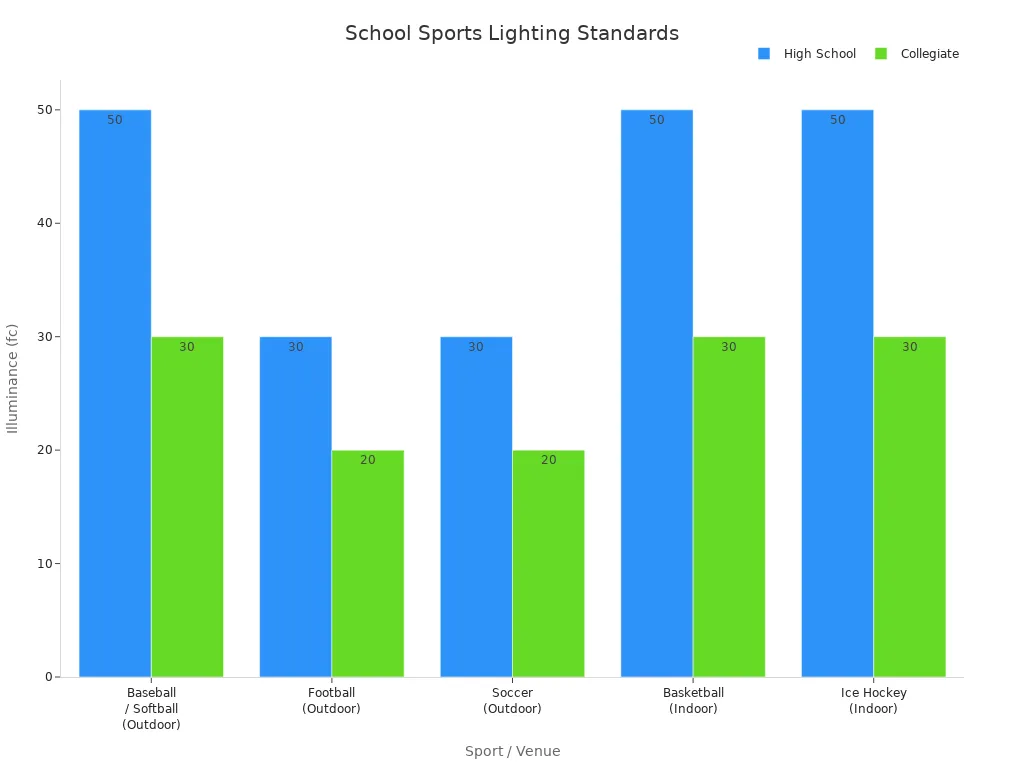
Outdoor lighting for sports fields must be configured based on site conditions, lighting calculations, and local standards. You should select products that provide consistent illumination and support campus infrastructure.
Part2: Safety & Visibility Requirements
2.1 Safety Standards & Student Safety
You must follow strict safety standards when designing lighting solutions for school campuses and transportation areas. These standards help you protect students and create safer environments. You need to select lighting products that deliver consistent illumination and reduce glare. Proper lighting levels support student safety and improve visibility for everyone on campus. The table below shows recommended footcandle requirements for different areas:
| Area Type | Footcandle Requirement |
|---|---|
| Open Parking Areas | 1.0–2.0 footcandles |
| Entry and Exit Points | 2.0–5.0 footcandles |
| Sidewalks and Crosswalks | 1.0–3.0 footcandles |
| ADA Accessibility Areas | 2.0–5.0 footcandles |
You must assess each area and adjust lighting levels based on site conditions, campus infrastructure, and local standards. You should use energy-efficient street lighting and LED street lighting to meet these requirements. Annual safety audits show that outdoor lighting contributes to student safety in many ways:
| Area | Lighting Contribution to Safety |
|---|---|
| Classrooms | Adequate lighting is essential for reading and learning. |
| Art Rooms | Brighter lighting with high color accuracy enhances safety. |
| Gymnasiums | Proper lighting ensures visibility during physical activities. |
| Libraries | Well-lit spaces promote safety and comfort for students. |
| Emergency | Systems must be tested to ensure compliance during outages. |
You need to test emergency lighting systems regularly and verify compliance with all codes. Consistent illumination helps you reduce shadows and improve security across the campus.
2.2 Visibility for Pedestrians & Vehicles
You must prioritize visibility for pedestrians and vehicles in all outdoor areas. Enhanced lighting solutions help you prevent accidents and support safe movement. You need to use outdoor lighting that provides even illumination and reduces glare. National safety organizations recommend several measures to improve visibility in school zones:
| Visibility Measure | Description |
|---|---|
| New sign and plaque designs | Fluorescent yellow-green standards for higher visibility of school speed limits. |
| Revised crosswalk marking guidance | Emphasizes durability and visibility both during the day and at night. |
| Rectangular rapid flashing beacons (RRFBs) | Proven countermeasures to enhance visibility and alert drivers. |
| LED-Enhanced Flashing Warning Signs | Increases driver compliance and awareness at key approach points, especially in low-light areas. |
| Flashing Beacons and Lighting | Enhances visibility during critical hours, serving as a deterrent to unsafe speeds. |
| Enhanced Lighting at Crosswalks | Ensures drivers can see students clearly, particularly during early morning or late afternoon. |
You should install LED street lighting and outdoor lighting at crosswalks, entry points, and access roads. You need to select products that match the campus infrastructure and provide consistent illumination. Enhanced visibility supports pedestrian safety and reduces risks for students and drivers.
2.3 Security Integration
You must integrate lighting solutions with campus security systems. Outdoor lighting helps you deter unauthorized access and improve surveillance. You need to use lighting controls and smart accessories to support security operations. Consistent illumination across outdoor areas reduces blind spots and supports camera coverage. You should coordinate lighting placement with security teams and infrastructure planners. Enhanced lighting in parking lots, walkways, and transportation zones helps you protect students and staff during critical hours.
Tip: You can improve security by combining lighting solutions with access control systems and emergency communication devices.
2.4 Compliance & Local Codes
You must comply with all local codes and national standards when installing lighting solutions. You need to select UL-listed devices and follow NEC and NFPA requirements. Installations must meet ADA accessibility standards and ASHRAE energy efficiency guidelines. The table below summarizes key compliance requirements:
| Compliance Requirement | Description |
|---|---|
| NEC Articles | 210, 250, 300, 517, 700, 760 |
| NFPA 70 | National Electrical Code |
| NFPA 72 | Fire Alarm Code |
| ADA Compliance | Switch heights and access |
| ASHRAE 90.1 | Energy efficiency |
| UL-listed Devices | Safety standards |
- All lighting installations must comply with local electrical codes.
- Installations should be performed by qualified professionals.
You must evaluate site conditions, wind load, soil, and climate before selecting products and configurations. You need to document all project parameters and verify acceptance criteria with local authorities. Compliance ensures you deliver safe, reliable, and energy-efficient lighting solutions for college campuses and transportation areas.
Part3: Product Selection & Engineering Configuration
3.1 LED Lighting Solutions
You can select LED lighting solutions to improve energy efficiency and reduce maintenance costs across your campus infrastructure. LED street lights use up to 75% less energy than older technologies. You benefit from a lifespan of 25,000 to 50,000 hours, which means fewer replacements and lower maintenance expenses. Smart lighting controls help you optimize energy use and enhance comfort for students and staff. For example, Michigan City Area Schools combined LED retrofits with solar energy and expects to save $23 million over 30 years. Ysleta Independent School District improved illumination levels and created a better learning environment with LED upgrades. Studies show that well-designed lighting increases student focus and reduces fatigue, supporting academic performance. Peachtree Lighting’s LED fixtures use up to 70% less energy and help you meet budget constraints while providing consistent illumination.
- LED street lights deliver reliable performance for outdoor areas.
- You can integrate smart controls for automatic dimming and scheduling.
- LeapPole offers engineering customization and product supply for LED street lights, ensuring quality control and documentation support.
For more details on selecting LED street lights for campus infrastructure, visit LED street light product selection and engineering configuration.
3.2 Solar Street Lights
Solar street lights provide sustainable lighting solutions for college campuses and student transportation areas. You invest in solar technology with a higher initial cost, but you save on operational expenses because solar street lights do not require electricity bills. Solar street lights reduce carbon emissions and use renewable energy, supporting environmental goals. Maintenance needs are lower due to fewer moving parts, but performance can vary with weather conditions. You must evaluate site conditions and climate before choosing solar street lights.
| Feature | Solar Street Lights | Traditional Street Lights |
|---|---|---|
| Initial Cost | Higher initial investment due to solar technology | Lower initial cost for installation |
| Operational Costs | Minimal ongoing costs, no electricity bills | Higher ongoing costs due to electricity consumption |
| Environmental Impact | Reduces carbon emissions and uses renewable energy | Higher carbon emissions due to reliance on fossil fuels |
| Maintenance | Requires less maintenance, fewer moving parts | Requires regular maintenance and repairs |
| Reliability | Performance can be affected by weather | Consistent performance regardless of weather |
LeapPole supplies solar street lights with engineering support, packaging, and transportation services. You can consult with LeapPole for project-specific recommendations and site evaluations. For guidance on solar street light selection, see solar street light engineering configuration.
3.3 Light Poles & Custom Poles
You need to match light poles and custom poles to your campus infrastructure and lighting objectives. Custom pole solutions allow you to adjust height, spacing, and mounting options for different functional areas. Environmental ratings and fixture durability are crucial for outdoor settings, ensuring longevity against weather exposure. LeapPole provides custom pole engineering, drawing support, and quality assurance for street lighting projects.
- Select pole materials and finishes based on climate and wind load.
- Use custom poles for sports fields, parking lots, and walkways.
- Coordinate pole placement with campus infrastructure and lighting calculations.
For more information on custom pole solutions, visit light pole engineering and customization.
3.4 Smart Controls & Accessories
Smart controls and accessories help you optimize lighting efficiency and simplify maintenance. You can use occupancy and vacancy sensors to detect active use and turn off lights in unoccupied areas. Daylight-responsive dimming adjusts artificial lighting based on natural light levels, conserving energy and maintaining comfort. Scheduling capabilities allow you to program lighting schedules to match building needs. Real-time analytics dashboards provide insights into energy usage patterns for better space management. Integration with building automation systems (BAS) creates a comprehensive energy management approach.
| Feature | Description |
|---|---|
| Occupancy and Vacancy Sensing | Detects active use of spaces and turns off lights in unoccupied areas to save energy. |
| Daylight-Responsive Dimming | Adjusts artificial lighting based on natural light levels to maintain comfort and conserve energy. |
| Scheduling Capabilities | Allows programming of lighting schedules to match building needs, enhancing energy efficiency. |
| Real-Time Analytics Dashboards | Provides insights into energy usage patterns for better space management and performance monitoring. |
| Integration with BAS | Coordinates with other building systems for a comprehensive energy management approach. |
LeapPole offers smart poles and accessories with engineering customization and documentation preparation. You can request project consultation for accessory selection and integration. For details on smart controls and accessories, see smart pole and accessory engineering configuration.
Tip: Smart controls help you reduce energy consumption and improve maintenance efficiency across campus infrastructure.
3.5 Project Parameters & Site Conditions
You must determine project parameters and site conditions before selecting lighting products. Environmental ratings and fixture durability are essential for outdoor settings. Lighting objectives must align with the needs of each area, such as controlled brightness and minimal glare for classrooms or consistent illumination for walkways. Mounting and installation conditions must match the intended use to prevent premature failures. You need to consider wind load, soil, climate, and local standards for every project.
- Assess site conditions for each functional area.
- Document project parameters and acceptance criteria.
- Consult with engineering partners for lighting calculations and configuration.
LeapPole provides engineering support, drawing preparation, and quality assurance for street lighting projects. You can request site-specific evaluations and documentation for project implementation. For more information on project parameters and site conditions, visit project engineering and site evaluation.
Note: Parameters must be determined based on site conditions, lighting calculations, wind load, soil, climate, and local standards. You should not use fixed parameters for all projects.
Part4: Installation & Standards

4.1 Installation Environment
You face several challenges when installing lighting systems for school infrastructure. Maintenance becomes difficult when fixtures are placed in hard-to-reach areas, causing disruptions during repairs. Outdated fluorescent lights can lead to eyestrain and fatigue, especially for students with sensory issues or learning disabilities. High energy costs from traditional lighting systems strain school budgets. You must consider wind load, soil conditions, and climate before selecting products for college campuses. Proper installation ensures reliable performance for LED street lights, solar street lights, and smart poles. LeapPole offers engineering support and site evaluation to help you address these challenges. For guidance on procurement and maintenance, visit procurement considerations and maintenance planning.
4.2 Standards & Acceptance
You must follow strict standards and acceptance criteria for lighting installations. ASHRAE 90.1-2022 sets lighting power density limits for different spaces. IES standards recommend foot-candle levels of 30-50 for classrooms. A color rendering index above 80 ensures clear vision. Uniformity and glare control prevent eye strain. The table below summarizes ASHRAE limits for educational spaces:
| Space Type | ASHRAE 90.1-2022 LPD Limit (W/sq ft) | Notes |
|---|---|---|
| Classroom / Lecture Hall | 0.71 | Applies to general classroom spaces |
| Laboratory | 1.28 | Higher allowance for task-intensive work |
| Library / Reading Room | 0.83 | Includes stacks and reading areas |
| Gymnasium | 0.94 | Covers multi-use gymnasium spaces |
| Cafeteria / Dining | 0.65 | Ambient dining environment |
| Corridor / Transition | 0.41 | Hallways and common transition areas |
| Stairwell | 0.49 | Safety lighting requirement |
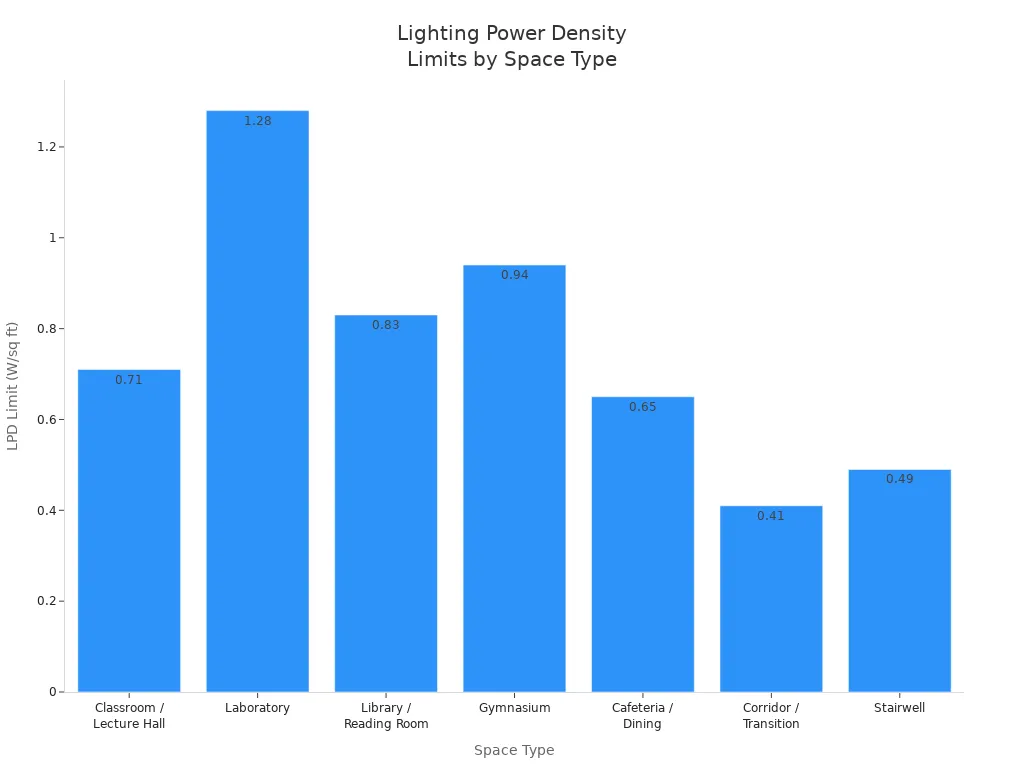
LeapPole provides custom solutions and documentation to meet acceptance requirements. For more details, see custom solutions for lighting infrastructure.
4.3 Inspection Criteria
You must use clear inspection criteria to ensure quality and compliance.
- Include thorough specification and documentation for wiring products in your project files.
- Build strong relationships with manufacturers and suppliers to access compliance data and product insights.
- Implement rigorous testing and inspection procedures throughout the project lifecycle.
Tip: Regular inspections help you maintain safe lighting for every pedestrian and support reliable infrastructure across college campuses.
Part5: Procurement, Maintenance & Support
5.1 Procurement Considerations
You must evaluate several factors when selecting lighting solutions for school infrastructure. Projects using federal funding require compliance with Buy America and BABA guidelines. Energy efficiency reduces operational costs, and tailored solutions ensure each area receives the right lighting. The table below summarizes key procurement considerations:
| Consideration | Explanation |
|---|---|
| Compliance | Follow federal guidelines for funded projects. |
| Energy Efficiency | Choose fixtures that lower long-term expenses. |
| Tailored Solutions | Match lighting to specific environments, such as labs or auditoriums. |
Nighttime safety improves student confidence. Solar area lights offer effective illumination without high infrastructure costs. Thoughtful outdoor lighting enhances security and supports sustainability goals. For more details, see lighting procurement and compliance documentation.
5.2 Maintenance & Lifecycle Costs
You benefit from LED street lights and smart poles because they require less maintenance and last longer. LEDs can operate for 50,000 to 100,000 hours, which means fewer replacements and lower costs. Energy-efficient LEDs consume up to 90% less energy than traditional options. The long-term savings often exceed the initial installation costs. Traditional lighting systems need frequent replacements, especially in hard-to-reach areas. The table below compares maintenance schedules:
| Lighting Type | Typical Lifespan | Maintenance Frequency | Annual Cost Estimate |
|---|---|---|---|
| LED Street Lights | 50,000–100,000 h | Minimal | Low |
| Fluorescent Tubes | 8,000–10,000 h | Frequent | High |
| Incandescent Bulbs | 1,000 h | Very Frequent | Highest |
You can find more information at maintenance planning and lifecycle cost analysis.
5.3 Quality Assurance
You must document all specifications and supplier support for lighting infrastructure. Strong relationships with manufacturers help you access compliance data and product insights. Rigorous testing and inspection procedures ensure safe lighting for every pedestrian and reliable performance across campus infrastructure. For guidance, see quality assurance and supplier documentation.
5.4 Engineering Support
You need engineering support to design lighting systems that enhance student performance and reduce absenteeism. Electrical engineers consider illuminance, color quality, and energy efficiency. Advanced technologies like multi-level switching and daylight harvesting improve classroom environments. Proper design and control measures support long-term project success. For technical guidance, visit engineering support and lighting configuration.
Tip: Always determine project parameters based on site conditions, lighting calculations, wind load, soil, climate, and local standards.
You improve student safety, visibility, and campus security with scenario-based lighting solutions. Consult engineering partners for tailored designs and reliable results. The table below highlights key benefits:
| Key Benefit | Description |
|---|---|
| Engineered Lighting Tailored | High-performance upgrades that reduce energy use and improve visual quality. |
| Precision Engineering & Implementation | Accurate design and documentation for each project. |
- Assess site conditions for every area.
- Select products based on function and compliance.
- Contact our team for configuration advice or quotations.
FAQ
What factors should you consider when selecting outdoor lighting for a school campus?
Assess the campus layout, traffic circulation, pedestrian activity, operating hours, security requirements, surrounding properties, climate, wind exposure, soil conditions, and applicable local standards.
Product selection should also consider optical distribution, glare control, color quality, ingress protection, impact resistance, control compatibility, maintenance access, and expected service life.
How do you configure lighting for different campus areas?
Evaluate each area according to its function. Bus loading zones, vehicle entrances, crossings, walkways, parking areas, sports-facility approaches, and building entrances may require different lighting criteria.
Use photometric calculations to determine the appropriate luminaire output, optical distribution, pole height, spacing, and uniformity. Avoid applying fixed values without confirming the relevant lighting class and local requirements.
How should lighting be designed for bus loops and student drop-off areas?
The design should clearly reveal pedestrians, vehicles, curbs, crossings, signs, and changes in direction. Pole placement must not obstruct bus movements, driver sightlines, canopies, traffic signs, or emergency access.
Lighting should remain reasonably uniform through vehicle and pedestrian conflict points. Excessive glare and sharp transitions between bright and dark areas should be avoided.
What are the best practices for integrating lighting controls with security systems?
Coordinate lighting schedules and control zones with school security personnel. Occupancy sensors, time schedules, remote monitoring, and emergency override functions can adjust lighting according to operating conditions.
Where cameras or other equipment share the same structure, use appropriately engineered smart poles rather than mounting additional equipment on standard poles without checking structural capacity, power routing, and maintenance access.
How do you ensure proper installation and project compliance?
Use approved drawings and qualified installation teams. Before installation, verify underground utilities, foundations, anchor bolts, pole alignment, luminaire orientation, electrical protection, earthing, control settings, and accessibility clearances.
After installation, conduct functional tests and nighttime measurements. Compare the results with the approved calculations, acceptance criteria, and applicable local requirements.
What maintenance practices support reliable campus lighting?
Establish an inspection schedule covering luminaires, lenses, poles, brackets, access doors, wiring, controls, surge protection, and foundations. Trees and landscaping should also be checked because new growth can block light or create uneven coverage.
Keep maintenance records and suitable replacement components available. Fault reporting and remote monitoring can help schools identify outages before they affect student transportation periods.
Can solar street lights be used on school campuses?
Yes. Solar street lighting systems may be suitable for remote walkways, perimeter roads, overflow parking, secondary entrances, or areas where electrical trenching is difficult.
The battery, solar panel, operating profile, and backup autonomy must be calculated from local sunlight, seasonal weather, shading, and required operating hours. Critical transportation areas may require grid-connected, hybrid, or independently backed-up lighting, depending on the project’s reliability requirements.
How can you request a customized campus lighting evaluation?
Submit the campus plan, traffic routes, bus circulation layout, pedestrian zones, operating schedule, environmental conditions, required standards, quantities, and tender specifications to LeapPole.
Contact LeapPole for project-specific recommendations covering LED luminaires, pole configurations, solar lighting, controls, and technical documentation.


