
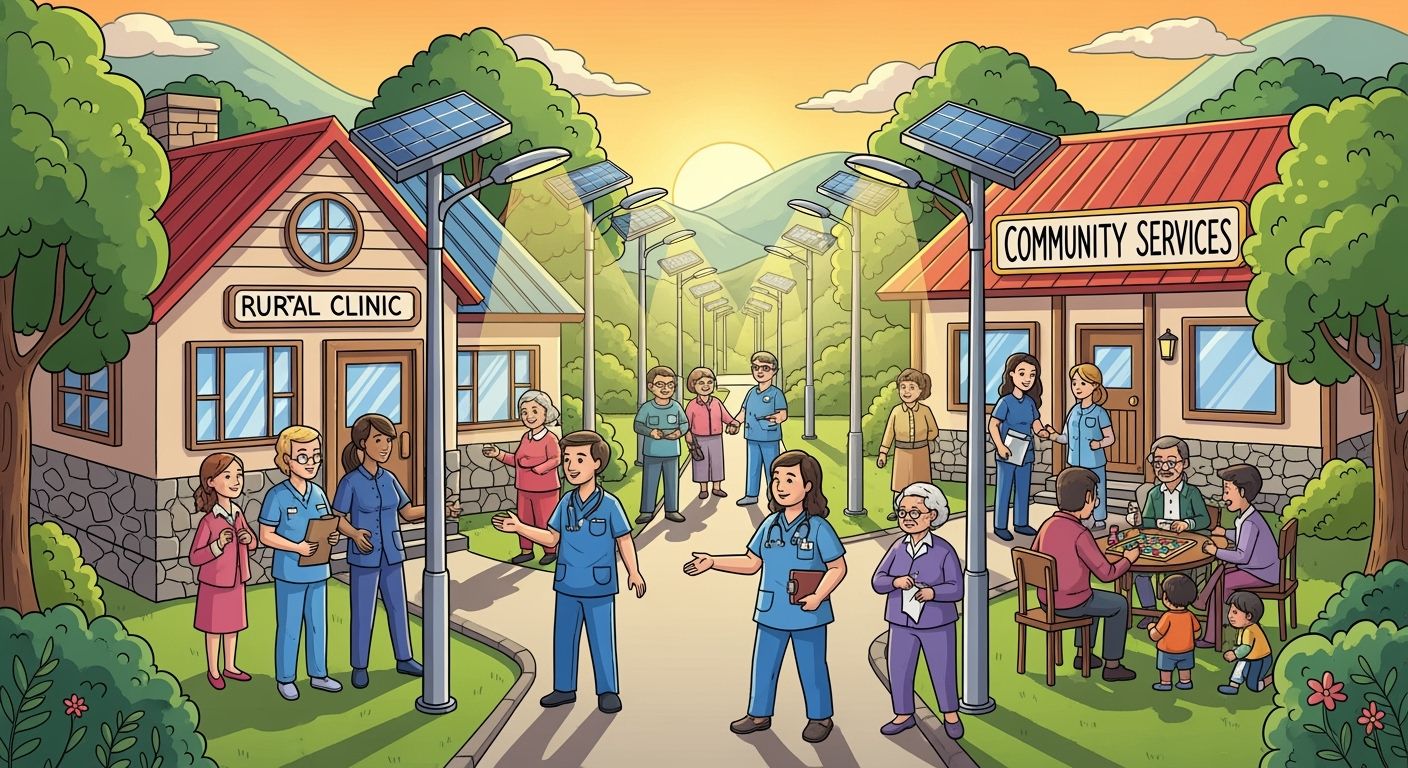
Reliable outdoor lighting is essential for rural clinics and community service centers that operate after sunset or provide emergency services around the clock. However, many remote facilities face unstable grid power, limited electrical infrastructure, or high cable installation costs.
Properly configured solar street lighting systems can illuminate clinic entrances, emergency access roads, pedestrian routes, parking areas, and surrounding public spaces without extensive trenching or grid dependence. This improves nighttime access, supports staff and visitor safety, and maintains essential outdoor lighting during local power outages.
For municipalities, contractors, NGOs, and healthcare infrastructure developers, successful implementation depends on site-specific lighting calculations, solar availability, battery autonomy, structural design, and long-term maintenance planning.
Key Takeaways
- Solar street lighting improves nighttime access to rural clinics and community service centers.
- Clinic entrances, ambulance routes, walkways, parking areas, and building perimeters require separate lighting assessments.
- Off-grid lighting reduces dependence on unstable power supplies and avoids extensive cable trenching.
- Battery and solar panel sizing must reflect local sunlight, operating hours, seasonal weather, and required backup autonomy.
- Pole strength, wind-load design, foundation conditions, and corrosion protection affect long-term system reliability.
- The choice between all-in-one and split solar street lights should be based on site conditions, energy demand, and maintenance requirements.
Part1: Solar Street Lighting Application Zones
1.1 Clinic Entrances & Emergency Access
You improve the safety and reliability of rural clinics by installing Solar Street Lighting at entrances and emergency access routes. These areas require clear visibility for patients, staff, and emergency vehicles. When you light entrances, you help drivers, cyclists, and pedestrians see obstacles and navigate safely. You also deter crime and vandalism, making the clinic feel secure for everyone. The table below shows how lighting at entrances supports safety and emergency response:
| Aspect | Benefit |
|---|---|
| Improved Visibility | Drivers, cyclists, and pedestrians see clearly and avoid hazards. |
| Crime Deterrence | Increased visibility discourages theft and vandalism. |
| Emergency Response Support | Emergency services reach patients faster when routes are well-lit. |
| Neighborhood Security | Residents feel safer and more comfortable visiting clinics at night. |
1.2 Parking & Drop-Off Areas
Solar Street Lighting provides consistent illumination in parking and drop-off zones. You make these areas safer for drivers and pedestrians, especially after dark. Reliable lighting encourages people to use the facilities at night and supports public safety. Because solar systems operate independently from the grid, you maintain lighting during power outages, which is crucial for clinics and community centers.
1.3 Walkways & Perimeter Security
You enhance walkway safety and perimeter security by using Solar Street Lighting. Well-lit paths help residents and staff move safely between buildings and parking areas. You reduce accidents and deter criminal activity by increasing visibility. Consider these documented effects:
- You illuminate dark areas, which discourages crime.
- You lower accident rates by improving visibility for pedestrians.
- You extend lighting to remote zones, making the entire site safer.
- You support navigation at night, reducing the risk of falls or injuries.
In countries like Canada and India, accident rates dropped by over 30% after installing solar street lights. Uganda also saw a significant decrease in incidents.
1.4 Community Spaces & Gathering Points
You empower community engagement by lighting gathering points, playgrounds, and event spaces. Solar Street Lighting makes these areas accessible for evening activities, markets, and meetings. You create a welcoming environment that encourages participation and reduces crime. Well-lit spaces support local economies and help vulnerable groups feel included.
Tip: Always assess lighting needs for each zone based on site conditions, local standards, and community requirements. You ensure optimal safety and usability by tailoring solutions to each project.
Part2: Lighting Needs and Design
2.1 Illumination & Uniformity
You need to assess the lighting requirements for each functional zone in your project. Proper illumination ensures safety and accessibility for patients, staff, and visitors. Uniformity helps prevent dark spots and shadows, which can lead to accidents or security concerns. The recommended levels for rural clinics and community centers vary by application type. Review the table below for typical standards:
| Application Type | Recommended Illumination Level | Uniformity Standard | Height | Power | Lumen Output | Solar Panel | Battery |
|---|---|---|---|---|---|---|---|
| Village / Township Roads | 5–8 lux | ≥0.30 | 6–7m | 40–60W | 6,000–9,000 lm | 200W | 20–40Ah LiFePO₄ |
| Parks, Campuses, Communities | 3–6 lux | ≥0.25 | 4–6m | 20–40W | 3,000–6,000 lm | 150–200W | 15–30Ah LiFePO₄ |
Note: You must determine exact specifications based on site conditions, lighting calculations, and local standards. These values serve as reference points for engineering evaluation.
2.2 Safety & Compliance Standards
You must follow safety and compliance standards when designing Solar Street Lighting systems. Local regulations often specify minimum illumination levels, pole spacing, and installation requirements. Compliance ensures reliable operation and protects users. You should verify standards for electrical safety, wind load, and soil conditions. Consult with local authorities and engineering partners to confirm requirements for each project scenario.
- Safety standards help prevent accidents and support emergency response.
- Compliance with regulations reduces liability and ensures project acceptance.
- You should document all design decisions for future maintenance and audits.
2.3 Site & Environmental Factors
Site-specific environmental factors play a critical role in lighting design. You need to evaluate sunlight availability, climate, and potential obstructions. Solar panels require direct sunlight to operate efficiently. Shading from trees or buildings can reduce energy collection, so you may need to relocate poles or trim foliage.
Key factors to consider:
- Ensure solar panels receive unobstructed sunlight.
- Assess geographic location and local climate for solar availability.
- Consider relocating poles or trimming foliage to optimize exposure.
| Factor | Description |
|---|---|
| Sunlight Availability | Latitude and longitude determine sun intensity and duration; obstructions can limit sunlight. |
| Environmental Conditions | Extreme temperatures, humidity, and exposure to elements affect performance and lifespan. |
| Material Selection | Choosing durable materials with high IP ratings ensures resilience against local weather. |
Solar Street Lighting systems operate independently, reducing the risk of failure during storms or outages. You benefit from vandalism-proof designs and fast installation, which restore safety quickly after disasters. NiMH batteries perform well in extreme temperatures, and cold weather can improve solar panel efficiency. You should adjust panel tilt angles to manage snow and optimize energy capture in winter.
Tip: Conduct a thorough site assessment before finalizing your lighting design. This step helps you identify potential issues and ensures optimal performance.
Part3: Product Selection & Engineering
3.1 Choosing Solar Street Lighting Systems
You start by identifying the lighting needs of each area in your project. Conduct a night-time assessment with community representatives to pinpoint zones that require illumination. Define clear lighting goals, such as minimum brightness and operating hours. Use a photometric plan to ensure light spreads evenly along roads and pathways. Size the energy system to handle the worst seasonal conditions, so your lights remain reliable year-round. Select durable components that withstand local weather, including rain, dust, and temperature extremes. LeapPole offers engineering support and documentation to help you tailor solutions for each site.
Tip: Always match your lighting system to the specific requirements of the clinic or community center. This approach ensures safety, accessibility, and long-term performance.
- Assess lighting needs with community input.
- Set illumination targets and operating schedules.
- Develop a photometric plan for optimal light distribution.
- Size solar panels and batteries for seasonal reliability.
- Choose robust materials for environmental durability.
3.2 Light Pole & LED Options
You select light poles and LED luminaires based on site conditions and project goals. LED technology delivers a long lifespan, often exceeding 50,000 hours, which reduces maintenance and replacement costs. Solar panels convert sunlight efficiently, providing power for decades with minimal degradation. Built-in batteries store energy, so your lights operate during power outages. This reliability is essential for clinics and community centers that depend on consistent lighting for safety. Traditional street lights require frequent bulb changes and incur hidden maintenance costs. Solar Street Lighting systems with high-performance LEDs last 20-25 years, minimizing disruptions and expenses.
LeapPole supplies a range of light poles and LED options, including smart poles and traffic infrastructure components. You can request technical drawings and product documentation to ensure compatibility with your site.
3.3 Key Parameters & Customization
You customize your lighting solution by evaluating technical parameters for each rural site. Remote locations often lack grid electricity, so solar systems are necessary. Unpaved and narrow roads affect pole placement and light distribution. Frequent rain and dust require weather-resistant designs. Budget constraints make cost-effective solutions vital. Self-cleaning features and high IP ratings improve efficiency and reduce maintenance. Optimal pole height and spacing ensure proper coverage. Advanced solar panels perform well in changing weather. Adaptive motion sensing saves energy and reduces light pollution.
| Parameter | Description |
|---|---|
| Lack of Grid Electricity | Remote locations often lack access to traditional power sources, necessitating solar solutions. |
| Unpaved & Narrow Roads | Rural areas may have challenging road conditions that affect light placement and distribution. |
| Frequent Rain & Dust Accumulation | Environmental factors like rain and dust can impact the efficiency and maintenance of lighting. |
| Budget Constraints | Cost-effective solutions are crucial for sustainability in rural settings. |
| Self-Cleaning & Weather-Resistant | Designs that prevent dust and water accumulation enhance lighting efficiency. |
| Optimal Pole Placement | Proper height and spacing ensure effective light distribution. |
| High-Efficiency Solar Panels | Advanced solar technology allows for better performance in varying weather conditions. |
| Adaptive Motion Sensing | Smart features that adjust lighting based on activity can save energy and reduce light pollution. |
LeapPole provides a comprehensive design process, including engineering analysis of sunlight and climate, lighting simulations, and customized system proposals. You receive technical support and installation guidance for each project scenario.
3.4 Smart Controls & Integration
You enhance efficiency and adaptability by integrating smart controls into your Solar Street Lighting system. Remote monitoring lets you access real-time data and manage systems without physical inspections. Automation uses sensors to adjust lighting based on ambient light and movement, optimizing energy use. User interaction improves through interfaces like TagoIO, which provide easy access to system data on multiple devices.
| Feature | Description |
|---|---|
| Remote Monitoring | Allows for real-time data access and system management without physical inspection. |
| Automation | Utilizes advanced sensors to adjust lighting based on ambient light and movement, optimizing energy use. |
| User Interaction | Enhanced through the TagoIO interface, providing easy access to system data on various devices. |
- Energy efficiency improves with motion sensors that adjust brightness based on traffic.
- Adaptive lighting ensures lights activate only when needed.
- IoT integration enables remote monitoring and control, increasing operational flexibility.
LeapPole offers smart control options and system integration support, helping you achieve reliable and efficient lighting for rural clinics and community centers.
Note: Specifications for power, pole height, spacing, foundation size, battery capacity, and solar panel wattage must be determined based on site conditions, lighting calculations, wind load, soil, climate, and local standards. Consult with engineering partners for project-specific verification.
Part4: Installation, Standards & Maintenance
4.1 Site Prep & Foundations
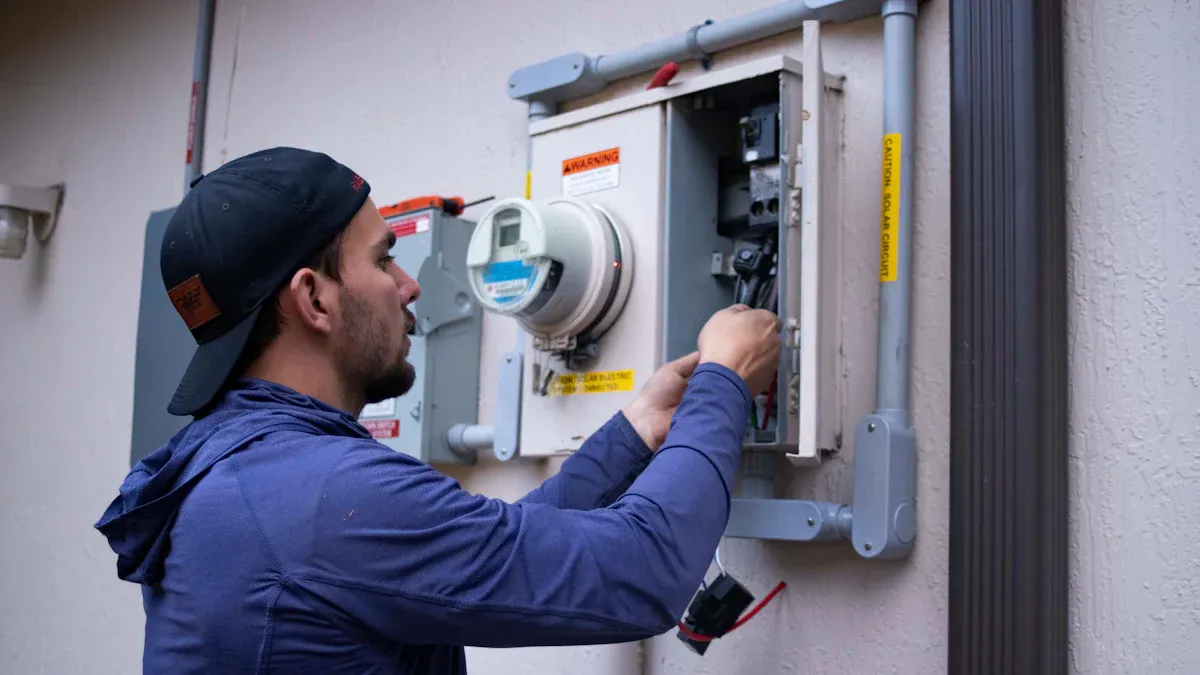
You start by selecting a site with strong sunlight and no obstructions. Avoid areas with underground cables or pipes. Ensure enough space for the foundation and proper coverage. Use a stable foundation that supports wind pressure and pole weight. Dig a cylindrical hole with straight sides, compact the bottom, and pour concrete with a slight slope for drainage. Follow these steps for foundation construction:
- Determine excavation size based on pole height and site conditions.
- Use graded crushed stone for soil reinforcement if needed.
- Lay a gravel bed and install a PVC drain pipe for water management.
- Fabricate a rebar cage and position anchor bolts accurately.
- Pour ready-mix concrete and cure it for at least seven days.
4.2 Installation & Local Standards
You must comply with local standards during installation. Check regulations for pole spacing, foundation depth, and electrical safety. Hire experienced professionals to avoid poor installation practices. Address common challenges such as insufficient sunlight, battery failures, LED malfunctions, and weather-related issues. Invest in robust materials and engage the community to deter vandalism and theft.
Tip: Always verify installation requirements with local authorities and adapt your plan to site-specific conditions.
4.3 Quality Control & Acceptance
You ensure reliability by performing voltage checks and activating the system at dusk. Observe illumination uniformity to eliminate dark spots. Clean solar panels every few months to maintain efficiency. Inspect cables and connections for wear and security. Follow troubleshooting protocols for common failure modes. Use a checklist for acceptance:
| Acceptance Criteria | Description |
|---|---|
| Voltage Check | Confirm system meets specifications |
| Illumination Uniformity | No dark spots or uneven coverage |
| Panel Cleanliness | Panels free from dust and debris |
| Cable Inspection | Secure and undamaged connections |
| Functional Test | System operates as designed |
4.4 Maintenance & Lifecycle Costs
You benefit from minimal maintenance and reduced lifecycle costs. Solar street lights require only one battery check and luminaire cleaning per year. Maintenance needs drop by 40% to 60% compared to traditional lighting. You avoid ongoing running costs because the system operates independently of the power grid. Traditional street lights need frequent bulb replacements and cable overhauls, leading to higher expenses.
4.5 Procurement Tips
You make informed procurement decisions by confirming technical parameters and reviewing product documentation. Request engineering drawings and certifications. Compare products based on durability, warranty, and compatibility with site conditions. Use a checklist to guide procurement:
| Procurement Checklist | Requirement |
|---|---|
| Technical Documentation | Drawings, specs, certifications |
| Warranty | Minimum 3–5 years recommended |
| Material Durability | High IP rating, weather resistance |
| Compatibility | Matches site and project needs |
| Support | Installation and maintenance guidance |
Note: Always tailor specifications for power, pole height, spacing, foundation size, battery capacity, and solar panel wattage to your project. Consult engineering partners for site-specific verification.
Solar Street Lighting delivers measurable improvements for rural clinics and community centers. You see enhanced safety, reliable access, and vibrant community spaces.
- Children study after dark.
- Local businesses extend productive hours.
- Public safety rises with better visibility.
- Environmental sustainability grows as you reduce reliance on fossil fuels.
To implement successful projects, follow these steps:
- Select sites with high traffic and assess lighting needs.
- Evaluate solar potential and ensure clear sunlight.
- Develop a budget and engage stakeholders.
- Confirm regulatory compliance.
Consult engineering partners like LeapPole for tailored configuration and project evaluation.
FAQ
How do you determine the right solar street lighting configuration for a rural clinic or community center?
Start by assessing the facility layout, operating hours, traffic activity, required lighting zones, and local solar conditions. Lighting and energy calculations should determine luminaire output, pole placement, solar panel wattage, battery capacity, and control settings. Wind load, soil conditions, temperature, and required backup autonomy must also be evaluated.
What factors influence the selection of light poles and LED luminaires?
Consider mounting height, optical distribution, required coverage, wind exposure, corrosion risk, maintenance access, and nearby buildings. Pole and luminaire specifications should be based on photometric and structural calculations rather than fixed standard values.
How do you ensure compliance with local standards during installation?
Review applicable lighting, structural, electrical, accessibility, and construction requirements before procurement. Use approved drawings, qualified installation teams, inspection records, and an acceptance checklist covering foundations, pole alignment, panel orientation, wiring, control settings, and nighttime operation.
What maintenance practices maximize the lifespan of solar street lighting systems?
Inspect solar panels, luminaires, brackets, cables, connectors, batteries, and control settings according to site conditions. Clean panels when dust, leaves, snow, or other deposits reduce solar collection. Additional inspections may be required after storms, flooding, construction work, or accidental impact.
Can solar street lighting be customized for different facility zones?
Yes. Entrances, emergency routes, parking areas, pedestrian paths, and perimeter zones can use different pole heights, optics, battery capacities, control programs, and mounting arrangements. The final configuration should reflect the operational importance and environmental conditions of each zone.
How do you start a technical evaluation or procurement process?
Submit the project location, site drawings, required operating hours, facility zones, quantities, environmental conditions, applicable standards, and tender specifications to LeapPole. Our team can evaluate these requirements and recommend an appropriate solar lighting configuration.
Ready to plan your rural healthcare or community infrastructure project? Contact LeapPole for a project-specific technical evaluation and quotation.


