
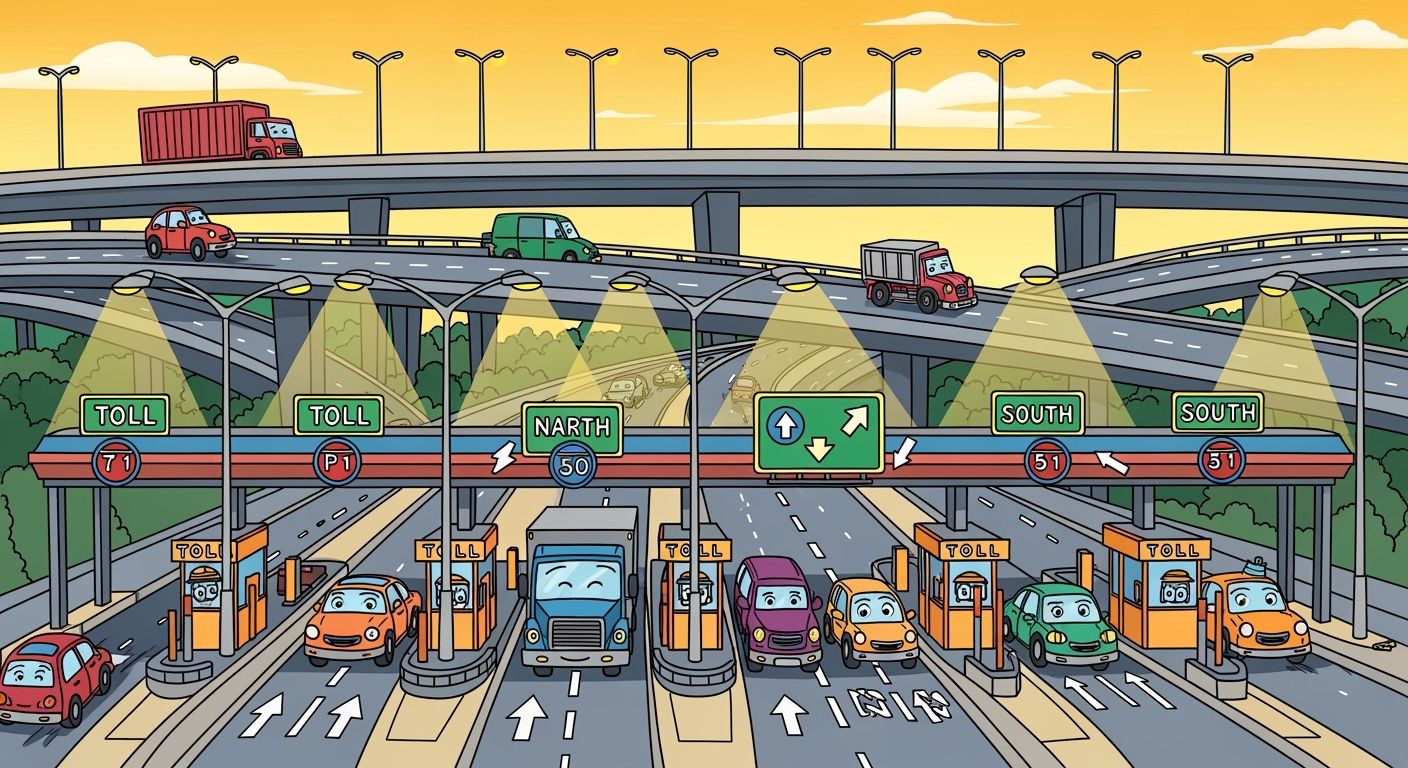
Effective street lighting design is essential for maintaining visibility, traffic flow, and operational safety at highway interchanges and toll plazas. These environments combine high-speed approaches, merging and diverging traffic, lane transitions, tolling equipment, signage, surveillance systems, and occasional pedestrian activity.
Lighting design should provide sufficient pavement visibility without creating excessive glare or abrupt transitions between bright and dark areas. Engineers must evaluate luminance or illuminance, overall uniformity, longitudinal uniformity, threshold increment, surrounding-area lighting, and visual guidance according to the applicable road class and local requirements.
For contractors, transport authorities, and infrastructure procurement teams, the final configuration must be supported by photometric calculations using the actual road geometry, LED street lights, pole positions, mounting heights, outreach arms, and luminaire optics.
Key Takeaways
- Divide interchanges and toll plazas into functional lighting zones instead of applying one configuration across the entire project.
- Maintain suitable lighting uniformity through approaches, merging areas, toll lanes, pedestrian crossings, and exit transitions.
- Evaluate glare, visual adaptation, signage visibility, and CCTV requirements alongside average lighting levels.
- Use the current ANSI/IES RP-8-25 and applicable transport authority requirements as design references.
- Coordinate luminaires and street light poles with tolling equipment, signs, cameras, barriers, and other roadside infrastructure.
- Use LED lighting and adaptive controls to reduce unnecessary energy consumption during periods of lower traffic.
- Consider solar street lights primarily for remote approaches, perimeter roads, service areas, or other locations where grid extension is impractical.
- Verify the design through site-specific photometric calculations, structural analysis, installation inspection, and nighttime acceptance testing.
Part1: Application Scenarios and Zones
1.1 Interchange Types
You encounter several main types of highway interchanges in modern infrastructure projects. Each type presents unique challenges for street lighting design.
- Cloverleaf interchanges use loop ramps to manage traffic flow. These require careful placement of luminaires to avoid shadowed zones and ensure visibility on curved paths.
- Diamond interchanges feature straight ramps and cross streets. You must focus on uniform lighting at ramp terminals and merge points.
- Directional and trumpet interchanges handle high-speed, high-volume traffic. Fixed-source lighting becomes crucial in these settings. It helps drivers see the roadway and other vehicles clearly. An unlit interchange can reduce effectiveness and cause drivers to slow down due to uncertainty. The AASHTO Green Book highlights the importance of lighting, especially as traffic volume increases.
1.2 Toll Plaza Layouts
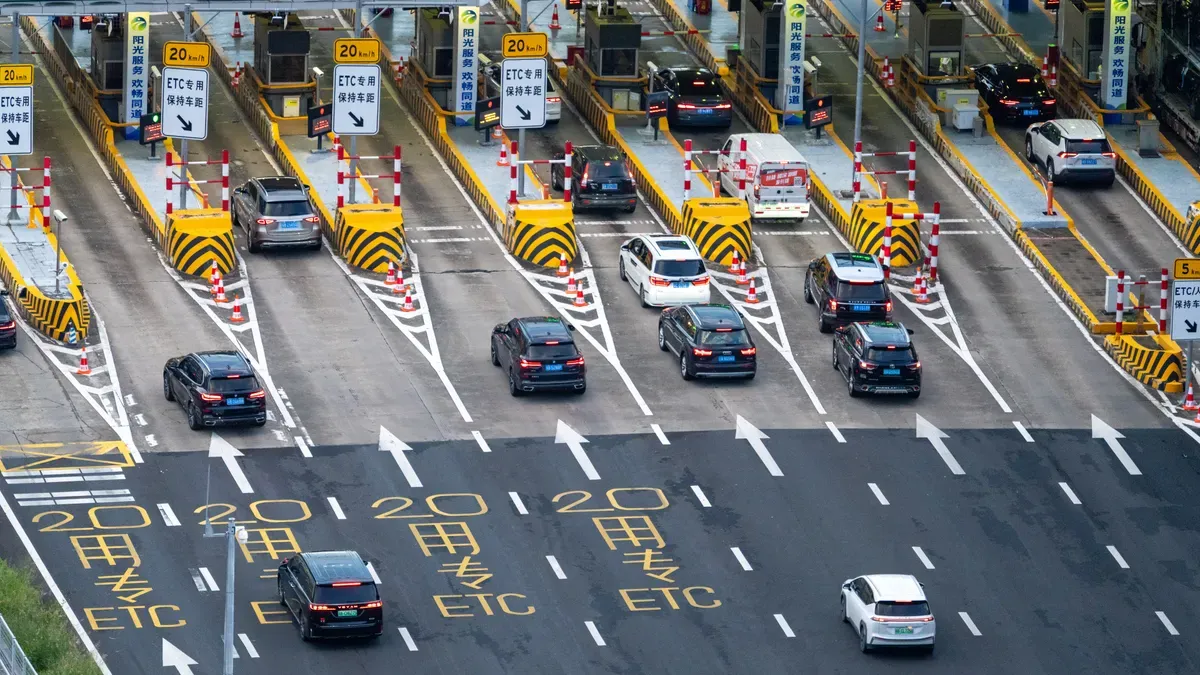
Toll plazas come in various layouts, such as barrier, open road, and mixed-mode configurations. You must analyze each layout to determine the best lighting approach.
- Barrier toll plazas concentrate vehicles at payment points. You need to provide high illuminance and uniformity to support safe transactions and clear lane markings.
- Open road tolling allows vehicles to pass at highway speeds. Lighting should extend beyond the tolling area to cover approach and departure zones.
- Mixed-mode layouts combine manual and electronic lanes. You must ensure consistent lighting across all lanes to prevent confusion and support efficient operations.
1.3 Key Functional Areas
You should identify and prioritize key functional areas for effective street lighting design. These include:
- Mainline roadways and ramps, where you must maintain consistent luminance for driver guidance.
- Toll collection zones, which require enhanced visibility for staff and equipment.
- Pedestrian crossings and inspection areas, where safety risks increase without proper illumination.
- Approach and departure zones, which benefit from lighting transitions that reduce glare and sudden changes in brightness.
Tip: Always base your lighting zones and levels on site-specific factors and current standards. This approach ensures compliance and optimal performance for each project scenario.
Part2: Lighting Needs and Objectives
2.1 Safety and Visibility
You must prioritize safety and visibility when planning street lighting design for highway interchanges and toll plazas. High-speed traffic and complex lane changes increase the risk of accidents, especially at night. Proper illumination helps drivers recognize road geometry, signage, and obstacles in time to react safely. You should ensure that lighting eliminates dark spots and reduces glare, which can cause confusion or temporary blindness. Reliable visibility supports both drivers and pedestrians, especially in areas where staff or inspectors operate near moving vehicles. Always reference current standards, such as those from AASHTO and IES, to determine the appropriate lighting levels for each functional area.
2.2 Traffic Flow and Operations
Efficient traffic flow depends on your ability to provide consistent and adequate lighting. Well-designed lighting systems help drivers judge distances, lane positions, and merging opportunities. This reduces hesitation and erratic maneuvers, which can disrupt operations. The following table summarizes how street lighting design contributes to operational performance:
| Evidence Type | Description |
|---|---|
| Night Accident Reduction | Adequate lighting can significantly reduce night accidents by improving visibility and orientation for drivers. |
| Traffic Flow Improvement | Proper lighting enhances traffic flow by aiding drivers in judging roadway conditions and opportunities for overtaking. |
| Safety Promotion | Well-designed lighting systems promote safety by providing quick and accurate seeing conditions for drivers and pedestrians. |
You should extend lighting coverage to approach and departure zones to maintain smooth transitions and prevent bottlenecks. Consider the impact of lighting on toll collection efficiency and the movement of vehicles through inspection points.
2.3 Security and Community Impact
You also need to address security and community concerns in your lighting objectives. Sufficient illumination deters vandalism and theft at toll plazas and inspection areas. It also supports surveillance systems and emergency response. In addition, you should minimize light pollution and glare that could affect nearby communities. Use shielded luminaires and smart controls to direct light only where needed. This approach balances operational needs with environmental responsibility and public acceptance.
Note: Always tailor your lighting solutions to the unique requirements of each site, considering both technical standards and local context.
Part3: Street Lighting Design Standards and Criteria

3.1 Key Standards Overview
You must understand the main standards that guide street lighting design for highway interchanges and toll plazas. These documents provide the foundation for safe and effective lighting solutions. Each standard addresses different aspects of roadway and outdoor lighting. The following table summarizes the most important references you should consult during your project planning and execution:
| Document | Description |
|---|---|
| AASHTO GL-6 | Roadway Lighting Design Guide |
| ANSI/IES RP-8 | Standard Practice for Roadway Lighting |
| ANSI/IES RP-22 | Standard Practice for Tunnel Lighting |
| IES DG-19 | Design Guide for Roundabout Lighting |
| FHWA-RD-01-103 | Highway Design Handbook for Older Drivers and Pedestrians |
| TAC Guide | Guide for the Design of Roadway Lighting 2006 Edition |
You should always reference these standards to ensure your lighting design meets current safety, visibility, and operational requirements. These documents help you address the unique challenges of complex traffic environments and support compliance with national and regional regulations.
3.2 Luminance Method Application
You need to apply the luminance method when designing lighting for highway interchanges and toll plazas. This method focuses on measuring the brightness of the road surface as seen by drivers, using units of candela per square meter (cd/m²). The luminance method evaluates three main metrics:
- Average luminance: Measures the overall brightness of the roadway.
- Uniformity ratios: Assesses how evenly light spreads across the surface.
- Veiling luminance ratios: Evaluates glare and its impact on driver visibility.
You should use the luminance method to create a safe and comfortable visual environment. This approach helps you reduce glare, avoid dark spots, and maintain consistent visibility for all users. Symmetrical lighting arrangements often work best in these settings. You should also extend lighting coverage on approaches and departures to support smooth transitions and reduce sudden changes in brightness. Always adjust your design based on site-specific factors, such as road geometry, traffic volume, and environmental conditions.
Tip: Use lighting simulation software to model luminance levels and uniformity before finalizing your design. This step helps you identify potential issues and optimize your layout for real-world conditions.
3.3 Compliance and Acceptance
You must ensure your street lighting design complies with all relevant standards and project requirements. Compliance involves more than just meeting technical specifications. You need to address functional needs and safety criteria for each project scenario. Key compliance requirements include:
- Lighting is warranted for illuminating acceleration lanes, deceleration lanes, weaving areas, or walkways.
- Minimum lighting requirements:
- Two luminaires at each freeway exit ramp.
- One luminaire at each freeway entrance ramp.
- Safety lighting is warranted if:
- Total average daily traffic (ADT) ramp traffic exceeds 5,000 in urban areas, 3,000 in suburban areas, and 1,000 in rural areas.
- ADT on the freeway exceeds 25,000 in urban areas, 20,000 in suburban areas, and 10,000 in rural areas.
- Lighting must facilitate decision-making and lane changing during darkness.
You should document your compliance process and coordinate with local authorities for project acceptance. Regular inspections and testing help you verify that your installation meets all performance and safety standards. Always update your practices as standards evolve and new technologies become available.
Note: Site-specific analysis is essential. You must tailor your lighting solutions to the unique needs of each interchange or toll plaza, using standards as a guide rather than a fixed template.
Part4: Product Selection and Configuration
4.1 Light Pole Types and High Mast Solutions
You must evaluate different light pole types and high mast solutions for each project scenario. High mast lighting offers several advantages for highway interchanges and toll plazas:
- Wide-area coverage with fewer pole positions.
- Fewer ground-level obstructions, which improves circulation for large vehicles.
- Efficient layouts for large operational environments.
- Strategic lighting points that enhance visibility.
The following table summarizes the main advantages and disadvantages of high mast lighting:
| Advantages of High Mast Lighting | Disadvantages of High Mast Lighting |
|---|---|
| Uniform, visible lighted area for drivers | Light trespass into nearby residential areas |
| Setback from pavement reduces collision risk | Light pollution complaints from homeowners |
| One high mast can replace 10–15 poles | Maintenance challenges (e.g., nesting birds) |
| Safer maintenance (no lane closures) | Needs lightning protection in storm-prone areas |
| Suited for complex, high-speed interchanges | Lowering required during hurricane warnings |
High mast systems often reduce installation costs at interchanges due to fewer fixtures. Conventional poles may have lower initial costs outside interchanges but require more frequent maintenance and traffic control. You can explore more about street light poles for detailed engineering options.
4.2 LED and Solar Street Lights
You should consider both LED and solar street lights for highway projects. LED street lights deliver energy savings, longer lifespan, and better uniformity. They also provide instant on/off capability, which enhances safety during power cycling. Solar street lights operate autonomously and support renewable energy goals. The table below compares key factors:
| Factor | LED Street Lights | Solar Street Lights |
|---|---|---|
| Upfront Cost | $3,000–$5,000 per fixture | $2,500–$4,000 per fixture |
| Long-Term Cost | $150–$250 yearly utility | Zero electricity costs |
| Maintenance | Higher (grid dependence) | Lower (panel cleaning, battery) |
| Sustainability | Moderate | High (renewable energy) |
| Power Source | Electrical grid | Solar energy |
| Installation | Requires trenching | No wiring required |
| Best Use Case | Urban highways | Rural/remote highways |
LED street lights align with energy efficiency standards and reduce carbon emissions. Solar street lights, especially all-in-one solar street lights, excel in remote areas with unreliable grid power. LeapPole provides engineering customization and technical support for both solutions.
4.3 Integration with Traffic Facilities
You must integrate lighting systems with traffic management facilities, such as toll booths, surveillance cameras, and signage. Proper integration ensures consistent illumination for all functional areas, including approach lanes, inspection zones, and pedestrian crossings. You should coordinate lighting layouts with other infrastructure to avoid conflicts and maximize operational efficiency. LeapPole supports project-specific integration, offering tailored solutions for complex environments.
Tip: Use lighting simulation tools to coordinate pole placement with traffic equipment and ensure compliance with local standards.
4.4 Key Parameters and Site Factors
You need to determine key parameters—such as power rating, pole height, spacing, and mounting type—based on site conditions, lighting calculations, and applicable standards. Do not use fixed values for all projects. Instead, assess factors like road geometry, traffic volume, and environmental constraints. Reference standards such as AASHTO and ANSI/IES RP-8 for guidance. For specialized applications, consult with engineering partners like LeapPole to ensure compliance and optimal performance. Explore LED street lights and solar street lights for industrial parks for more technical details and case studies.
Note: Always document your parameter selection process and validate it through simulation and field testing.
Part5: Installation and Maintenance
5.1 Site Preparation and Construction
You must start with thorough site preparation before installing street lighting systems. Clear the work area of debris and obstacles. Mark underground utilities to prevent damage during excavation. Check soil conditions to ensure stable foundations for light poles and high mast structures. You should coordinate with civil and electrical teams to align pole locations with road geometry and traffic facilities. Use approved construction drawings and follow all safety protocols. Schedule work to minimize disruption to traffic and toll operations. Always verify that materials and components meet project specifications and relevant standards.
5.2 Quality Control and Acceptance
You need to implement strict quality control throughout the installation process. Inspect each component—such as poles, luminaires, wiring, and control systems—before and after installation. Use an acceptance checklist to confirm compliance with standards like AASHTO and ANSI/IES RP-8. The table below outlines key acceptance items:
| Acceptance Item | Requirement Example | Reference Standard |
|---|---|---|
| Pole Alignment | Vertical within 1% tolerance | AASHTO GL-6 |
| Luminance Uniformity | Meets design simulation | ANSI/IES RP-8 |
| Wiring Integrity | No exposed or damaged conductors | NEC |
| Grounding Resistance | Below specified maximum | Local Electrical Code |
| Control System Test | All functions operate as designed | Project Specification |
Document all inspections and test results. Address any deficiencies before final acceptance. Coordinate with local authorities for official sign-off.
5.3 Maintenance Planning
You should develop a proactive maintenance plan for long-term reliability. Schedule regular inspections for luminaires, poles, and electrical systems. Clean lenses and solar panels to maintain optimal light output. Replace damaged or failed components promptly. Monitor system performance using smart controls or remote monitoring when available. Plan for periodic upgrades as standards and technology evolve. Consider environmental factors, such as corrosion or extreme weather, in your maintenance strategy. Reference manufacturer guidelines and industry standards for recommended practices.
Tip: Keep detailed maintenance records. These help you track performance trends and support future upgrades or audits.
Part6: Procurement and Cost Considerations
6.1 Certification and Quality Assurance
You must select street lighting products that meet strict certification and quality requirements. These certifications ensure that your lighting systems perform reliably and comply with regional regulations. Key certifications include:
- DLC Certification: This certification is essential for accessing utility and efficiency programs across the US and Canada. Many rebate programs require DLC-listed products, which can lower your project costs.
- California Title 24 Compliance: Starting January 1, 2026, all lighting products for new construction in California must display JA8-2025 or JA8-2025-E labels and be registered in the CEC database.
You should always verify that your selected products carry the necessary certifications for your project location. This step helps you avoid delays during inspections and ensures eligibility for energy-saving incentives. For more details on compliance, refer to the ANSI/IES RP-8 standard.
6.2 Customization and Support
You can improve project outcomes by choosing products and solutions tailored to your site’s needs. Customization and engineering support address unique challenges at highway interchanges and toll plazas. The table below highlights how these features impact your project:
| Feature | Description |
|---|---|
| Extended spacing between poles | Reduces installation costs while maintaining required illumination levels. |
| Consistent illumination | Ensures driver visibility at high speeds, enhancing safety. |
| Durability | Withstands vibration from heavy truck traffic, ensuring longevity. |
| Compatibility | Integrates with smart control systems for adaptive dimming, improving energy efficiency. |
| High lumen output | Supports extended pole spacing and broad coverage. |
| IK10 impact rating | Survives in high-vibration environments, crucial for highway interchanges. |
Highway interchanges often require a mix of high mast and auxiliary poles to eliminate blind zones and optimize budgets. LeapPole’s engineering team can support you with layout optimization, product selection, and integration with smart controls.
6.3 Cost and Lifecycle Management
You should evaluate the total cost of ownership when planning your street lighting project. This includes initial procurement, installation, energy use, maintenance, and eventual upgrades. LED and solar street lights offer lower long-term costs due to energy savings and reduced maintenance. Smart controls can further decrease operational expenses by enabling adaptive dimming and remote monitoring.
You must also consider after-sales service and warranty support. Reliable partners provide technical assistance, spare parts, and system upgrades throughout the product lifecycle. This approach ensures your lighting system remains safe, efficient, and compliant as standards evolve. For more technical details, visit LED street lights for industrial parks.
Tip: Always base your procurement decisions on site-specific analysis, current standards, and long-term performance rather than just initial price.
Part7: Case Studies and Best Practices
7.1 Interchange Lighting Example
You can learn a lot from recent highway interchange lighting projects. Many engineers now use Complete Interchange Lighting (CIL) systems instead of Partial Interchange Lighting (PIL). CIL systems cover all ramps and weaving areas, which improves safety and traffic flow. The table below highlights key features found in successful projects:
| Feature | Description |
|---|---|
| Adequate Illumination Levels | Higher illumination levels help reduce crash rates at interchanges. |
| Complete Interchange Lighting | CIL systems outperform PIL systems in both safety and traffic movement. |
| Smart Technologies | Adaptive lighting controls improve safety, especially for older drivers. |
You should always use LED technology for energy efficiency and lower maintenance. Smart controls allow you to adjust lighting based on traffic and weather. For example, a recent project on a major urban interchange used high mast LED fixtures with adaptive dimming. This setup improved visibility and reduced energy costs. You can find more details about high mast solutions in the street light pole engineering options section.
Tip: Always determine illumination levels and pole placement based on site-specific factors and current standards.
7.2 Toll Plaza Lighting Example
You can see the value of proper lighting design in toll plaza projects. Many teams use symmetrical lighting arrangements to provide even coverage. The choice between high pole and low pole lighting depends on the site’s needs. Here are some lessons learned from recent projects:
- Proper lighting design improves safety and visibility for drivers and staff.
- Symmetrical arrangements help eliminate dark spots and confusion.
- You should select pole heights based on traffic speed, lane width, and local conditions.
Best practices for toll plaza lighting include:
- Use LED fixtures to save energy and reduce maintenance.
- Maintain average illumination levels between 0.8 and 1.0 foot candles.
- Keep uniformity ratios within 3:1 (average/minimum) and 10:1 (maximum/minimum).
- Hire professional installers to meet local codes and standards.
- Add dedicated lighting for overhead signs and underdeck areas.
You can explore LED street lights for industrial parks for more technical guidance on fixture selection and layout. Always tailor your design to the unique requirements of each toll plaza, using standards as your guide.
Note: Document your lessons learned and update your practices as technology and standards evolve. This approach ensures long-term safety and efficiency.
You play a vital role in creating safer and more efficient highways by following street lighting design standards and best practices. The ANSI/IES RP-8-22 document shows that proper lighting reduces nighttime collisions and improves visibility at interchanges and toll plazas. You should consult current guidelines, work with experienced engineers, and plan for regular maintenance. Start by assessing your site, selecting products based on project needs, and documenting each step for compliance and long-term success.
FAQ
How do you determine the right lighting configuration for a highway interchange?
Analyze the interchange geometry, traffic speed, traffic volume, lane arrangement, merging and diverging points, signage, surrounding brightness, and environmental conditions.
The lighting model should use the actual road dimensions, pole locations, mounting heights, outreach lengths, luminaire tilt angles, pavement properties, and maintenance factor. Avoid selecting pole spacing or fixture wattage from a fixed table without project-specific calculations.
Which lighting standard should you use for highway interchanges and toll plazas?
For projects following North American practice, consult the current ANSI/IES RP-8-25, which includes dedicated guidance for highways, interchanges, intersections, toll plazas, and other roadway applications.
AASHTO guidance, state or national transport authority specifications, electrical codes, and project-specific requirements may also apply. Always confirm the contractually required edition rather than automatically replacing the standard cited in an existing tender.
What certifications and reports should street lighting products provide?
There is no single certification that applies to every highway project. Required documentation may include accredited photometric test reports, IES files, electrical safety documentation, ingress and impact protection test data, surge protection information, material certificates, and structural calculations.
DLC listing may be requested for qualifying North American energy-efficiency or rebate programs, but it should not be presented as a universal roadway-lighting certification. California Title 24 is a regulatory compliance framework for applicable projects, not a product certification.
How do you integrate lighting with tolling and traffic facilities?
Coordinate the lighting layout with toll booths, lane-control signals, variable message signs, cameras, barriers, vehicle classification equipment, communication cabinets, and maintenance access.
Pole positions must not obstruct signs, camera sightlines, sensor detection zones, or vehicle clearance envelopes. LeapPole’s road traffic facilities can be coordinated with lighting poles and mounting structures during the design stage.
How should lighting transitions be managed around toll plazas?
Avoid abrupt changes between dark highway sections and brightly illuminated toll collection zones. The design should provide a controlled visual transition through the approach, transaction, and departure areas.
Review luminance ratios, glare, lane guidance, canopy lighting, signs, pavement markings, and surrounding ambient light. These requirements should be verified through calculations and nighttime commissioning rather than visual judgment alone.
Can solar street lights be used at highway interchanges and toll plazas?
Yes, but their suitability depends on the function of the lighting zone. Solar systems may be practical for remote ramps, service roads, perimeter areas, emergency access routes, or locations where trenching and grid extension are difficult.
Critical toll collection and high-traffic conflict areas may require grid-connected lighting, backup power, or a hybrid solution. Battery capacity, solar panel size, operating profile, and backup autonomy must be calculated using local weather and solar data.
What maintenance strategies support long-term reliability?
Establish a maintenance plan covering luminaire cleaning, electrical inspections, pole and bracket checks, surge protection, control systems, solar panels where applicable, and nighttime performance measurements.
Remote monitoring can help identify failed drivers, communication faults, abnormal energy use, and reduced light output. Maintenance access should be planned so crews can service equipment without creating unnecessary traffic disruption.
How can you obtain a project-specific lighting proposal?
Submit the interchange or toll plaza drawings, road geometry, pole locations, required lighting criteria, traffic-facility layout, environmental conditions, quantities, and tender specifications to LeapPole.
Contact LeapPole for a technical evaluation covering luminaire selection, pole configuration, photometric layout, structural requirements, and project quotation.


