
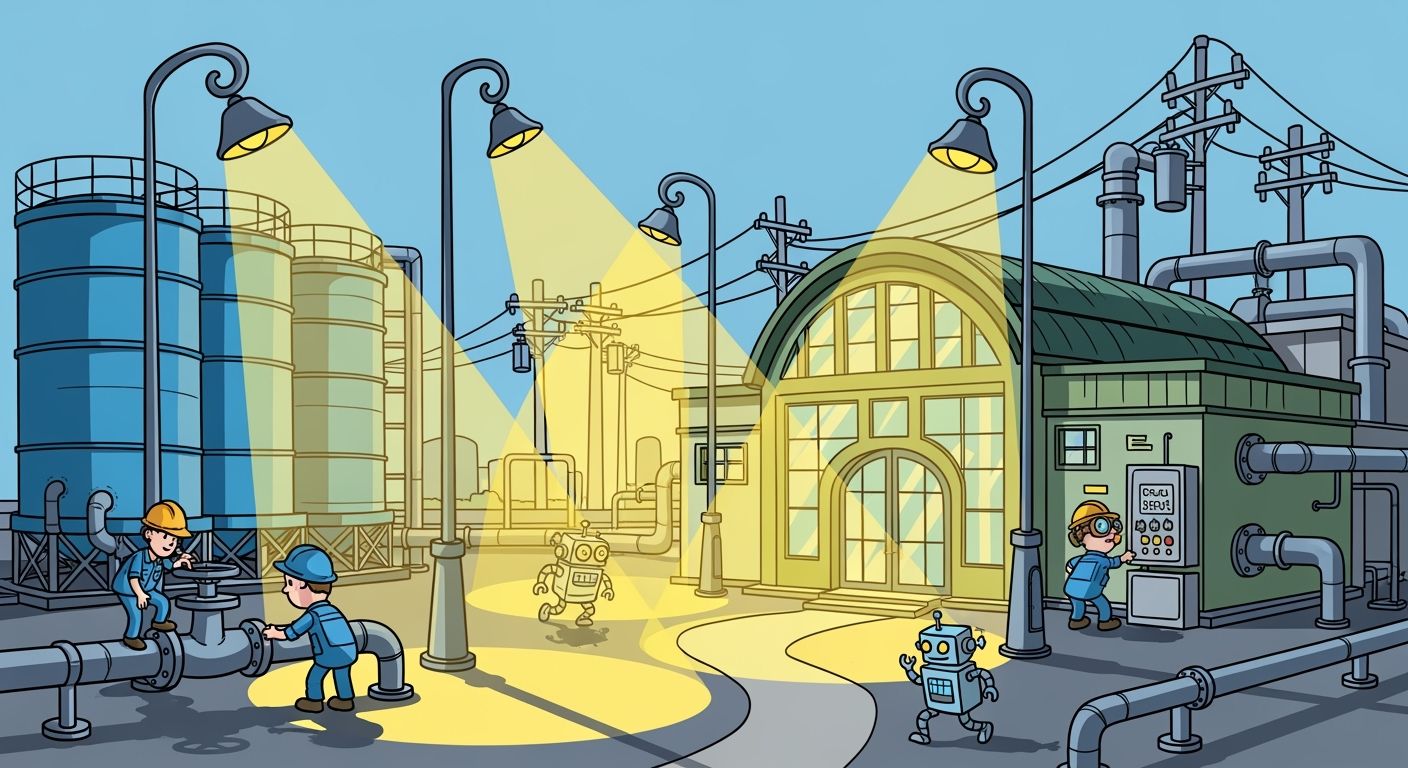
Water treatment plants and utility facilities require reliable outdoor lighting to maintain safe, secure, and continuous operations. Entrances, internal roads, process areas, equipment yards, parking areas, and facility perimeters each have different visibility and operational requirements.
Corrosive atmospheres, high humidity, chemical exposure, restricted maintenance access, and continuous operation make these projects more demanding than conventional roadway lighting. A suitable lighting system should combine durable LED luminaires, corrosion-resistant light poles, appropriate optical distribution, dependable controls, and project-specific structural engineering.
By coordinating lighting performance with site conditions and maintenance requirements, facility operators can improve worker safety, strengthen perimeter security, reduce energy consumption, and limit operational disruption.
Key Takeaways
- Prioritize lighting at entrances, internal roads, pedestrian routes, process zones, and facility perimeters.
- Use suitable LED street lights for grid-connected roads, parking areas, and equipment yards.
- Consider solar street lighting systems for remote intake stations, perimeter roads, and locations where cable trenching is impractical.
- Use photometric calculations to control illuminance, uniformity, glare, and light spill around sensitive process areas.
- Select corrosion-resistant luminaires, brackets, fasteners, and street light poles according to the site’s chemical and moisture exposure.
- Coordinate foundations, wind loads, electrical protection, controls, and maintenance access during the engineering stage.
Part1: Application Areas
1.1 Facility Entrances & Perimeters
You need to prioritize street lighting at facility entrances and perimeters. These areas often face vulnerabilities, especially in remote locations or sites with multiple access points. Proper illumination deters unauthorized access and supports surveillance systems. The table below highlights common vulnerabilities at entrances and perimeters:
| Vulnerability Type | Description |
|---|---|
| Remote locations | Many water utilities are situated in remote or isolated areas, making them more vulnerable to unauthorized access and intrusion. |
| Multiple access points | Water treatment plants often have multiple entry points, including gates, doors, and underground tunnels, which can be difficult to monitor and secure. |
| Sensitive equipment | Water facilities house essential, high-value equipment that requires continuous protection from theft, damage, and tampering. |
| Security lighting | Proper lighting around the facility’s perimeter is essential for deterring intruders and ensuring that surveillance cameras can capture clear footage during nighttime hours. |
You can enhance perimeter security by integrating street light poles with electric fences and surveillance cameras.
1.2 Internal Roads & Parking
Street lighting along internal roads and parking areas ensures safe navigation for vehicles and staff. Industry standards recommend specific illumination levels for these zones. The chart below shows minimum illumination requirements for different area types:
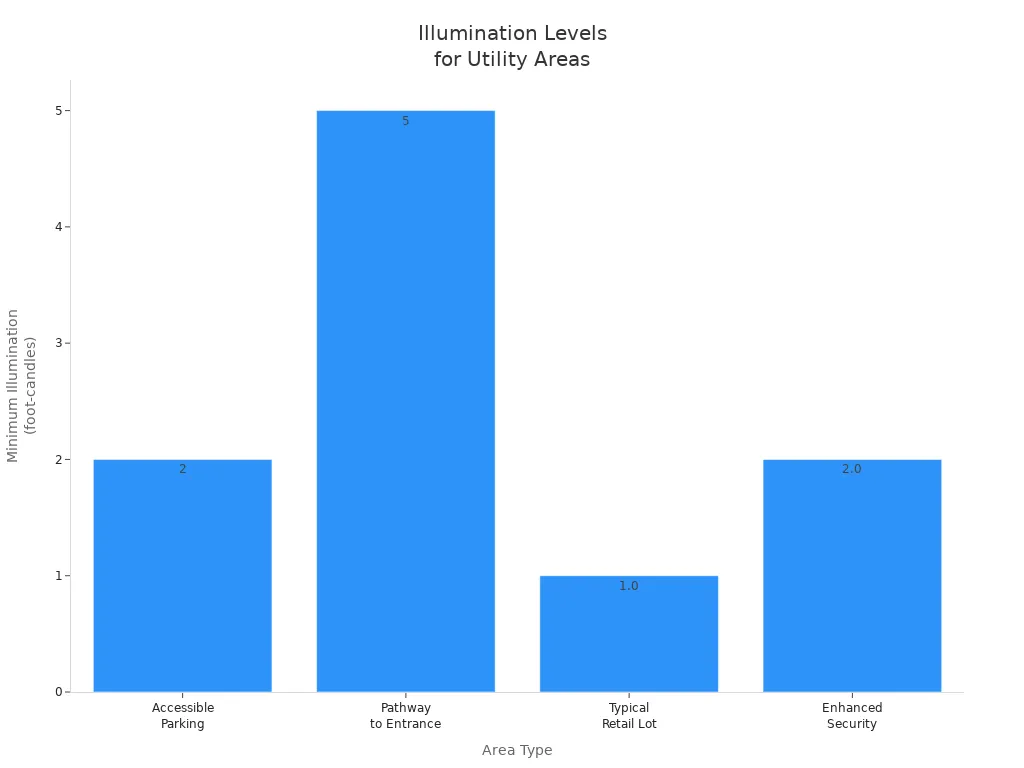
You should select LED street lights or all-in-one solar street lights for consistent coverage and energy efficiency. Uniformity and proper spacing of light poles help reduce shadows and improve visibility. For technical guidance, refer to internal road lighting standards.
1.3 Process Zones & Equipment Yards
Process zones and equipment yards require reliable street lighting to protect workers and maintain operational efficiency. Adequate illumination reduces accidents, improves productivity, and boosts morale. The table below summarizes key benefits:
| Benefit | Impact on Worker Safety and Efficiency |
|---|---|
| Reduction in Accidents | Enhances visibility, minimizing risks of accidents and injuries |
| Improved Productivity | Reduces eye strain and fatigue, allowing for efficient work |
| Boosted Employee Morale | Creates a safer environment, leading to higher job satisfaction |
You should use corrosion-resistant light poles and LED street lights in these zones. Smart poles with integrated controls can optimize lighting schedules and reduce maintenance. Learn more about process zone lighting solutions.
1.4 Security Fencing & Surveillance
Security fencing and surveillance zones demand strategic street lighting placement. You can eliminate dark corners and shadowy areas by installing fixtures at critical points, such as gates and corners. Consider these strategies:
- Integrate lighting with electric fences for continuous monitoring.
- Use motion sensors to trigger immediate illumination.
- Combine lighting with security cameras for clear image capture.
- Adjust fixture types and spacing based on security needs.
Smart controls and solar street lights offer flexibility and energy savings. For advanced options, explore smart pole integration for security lighting.
Part2: Street Lighting Requirements
2.1 Illumination Standards & Uniformity
You must follow strict illumination standards to ensure safety and operational efficiency in water treatment plants and utility facilities. Uniformity in lighting helps you maintain clear visibility and reduces the risk of accidents. The quality of illumination depends on the ratio of maximum to average or minimum light levels. This ratio affects how well you can see hazards and navigate the facility at night. Glare management is also important for driver comfort and pedestrian safety. You need to design lighting systems that minimize discomfort and support clear visibility.
| Aspect | Description |
|---|---|
| Uniformity | The ratio of maximum to average or minimum light levels, indicating quality and safety in visibility. |
| Glare Management | Important for driver comfort and pedestrian safety, requiring careful design to minimize discomfort. |
| Lighting Policies | Must maintain visibility and comprehension for drivers at all times, as per MUTCD guidelines. |
You should reference standards from the Illuminating Engineering Society (IES) and the Manual on Uniform Traffic Control Devices (MUTCD) for guidance on minimum illumination levels and uniformity ratios.
2.2 Coverage, Pole Height, Spacing
Street Lighting coverage impacts your ability to detect hazards and prevent unauthorized access. Proper coverage reduces shadows and blind spots, making it easier for you to spot intruders or obstacles. You need continuous lighting in high foot traffic areas. Motion-triggered lighting works well in less trafficked zones and can deter crime efficiently. Studies show that well-lit spaces reduce the likelihood of hidden crimes because offenders feel exposed.
- Proper lighting reduces shadows and blind spots, enhancing visibility and making it easier to detect unauthorized access.
- Continuous lighting in high foot traffic areas is effective for security, while motion-triggered lighting can deter crime more efficiently in less trafficked areas.
- Well-lit areas reduce the likelihood of hidden crimes, as potential offenders feel more exposed in visible spaces.
- Thermal and infrared cameras provide visibility in darkness, ensuring that coverage is maintained even in challenging weather conditions.
You must determine pole height and spacing based on site-specific conditions, standards, and calculations. Typical pole heights range from 20 to 40 feet, depending on the area and required coverage. Spacing between poles varies with the type of light fixture and the desired illumination level. You can use calculation tools from the International Electrotechnical Commission (IEC) and IES to confirm technical parameters.
| Parameter | Typical Range | Reference Standard |
|---|---|---|
| Pole Height | 20–40 feet | IEC 60598, IES RP-8-21 |
| Pole Spacing | 2–4 times pole height | IES RP-8-21 |
| Illumination | 5–20 lux (area-specific) | IES RP-8-21, MUTCD |
2.3 Glare Control & Light Pollution
You must address glare and light pollution when designing street lighting systems. Glare can cause discomfort and reduce visibility for drivers and workers. You need to select fixtures with proper shielding and optics to minimize glare. Light pollution affects the surrounding environment and can interfere with nearby residential areas or wildlife habitats. You should use LED street lights with precise beam control and consider cutoff fixtures to limit upward light spill.
Tip: Install fixtures at the correct angle and height to reduce glare and prevent light trespass. Use smart controls to adjust brightness based on operational needs.
You can reference IES TM-15 for guidance on light pollution and glare control.
2.4 Compliance & Local Codes
You must comply with local codes and national regulations when implementing street lighting in water treatment plants and utility facilities. Compliance requirements differ by facility type. Water treatment plants follow the Safe Drinking Water Act (SDWA), while wastewater facilities adhere to the National Pollutant Discharge Elimination System (NPDES). You need to document treatment techniques, calibration records, and monthly reports for water plants. Wastewater facilities require enforceable effluent limits and discharge monitoring.
| Utility Type | Governing Regulation | Key Compliance Requirements | Penalties for Noncompliance |
|---|---|---|---|
| Water Treatment Plants | Safe Drinking Water Act (SDWA) | Documented treatment technique compliance, chemical feed calibration records, monthly reports | Up to $25,000 per day per violation |
| Wastewater Facilities | National Pollutant Discharge Elimination System (NPDES) | Enforceable effluent limits, monthly discharge monitoring reports | Penalties and public disclosure for exceedances |
You must also follow local building codes and public works standards. Durable solutions are essential in corrosive environments. You should select corrosion-resistant light poles and certified LED street lights or solar street lights.
Note: Always consult with engineering partners and local authorities to confirm site-specific requirements and ensure compliance.
Part3: Product Selection
3.1 LED Street Lighting vs. Solar Street Lighting
You need to evaluate both LED street lighting and solar street lighting for utility facility projects. LED street lights offer high durability and consistent performance in corrosive and high-moisture environments. Their corrosion-proof design withstands harsh conditions typical in water treatment plants. Solar street lights provide significant energy savings and lower maintenance costs. You can expect annual maintenance costs for solar street lights to range from $10 to $50, while traditional systems may require $120 or more per year. Solar street lights also reduce energy costs by up to 75%. The table below compares annual energy costs:
| Lighting System | Annual Energy Cost |
|---|---|
| Traditional (100W) | $54.75 |
| Solar with Grid Backup | $5 – $15 |
3.2 Light Pole Types & Materials
Selecting the correct light pole material is essential for long-term reliability. Aluminum and fiberglass poles resist corrosion and environmental degradation, making them suitable for coastal or wet locations. Fiberglass poles offer longer durability and require less maintenance than aluminum. Steel poles provide strength but need regular painting or coating to prevent rust. The table below summarizes pole material options:
| Material Type | Advantages | Maintenance Needs |
|---|---|---|
| Steel | Strength and durability | Requires regular painting or coating |
| Aluminum | Lightweight and corrosion-resistant | Can suffer from fatigue over time |
| Fiberglass | Excellent resistance to environmental stressors | More susceptible to physical damage |
3.3 Smart Controls & Integration
Smart controls enhance operational efficiency and sustainability. You can integrate automated lighting controls with SCADA systems for improved oversight and management. Networked controls allow you to adjust lighting schedules, monitor energy consumption, and respond quickly to maintenance alerts. These features help you minimize energy use and optimize performance.
Tip: Smart controls support real-time monitoring and adaptive lighting, which improves reliability and reduces operational costs.
3.4 Engineering Support & Customization
Engineering support and customization improve performance and reliability in specialized environments. You benefit from intelligent controls, real-time monitoring, and advanced photometric analysis. LeapPole offers tailored solutions, including corrosion-resistant poles, optimized thermal management, and compliance with regulatory standards. Customization ensures consistent light output, longer lifespan, and energy efficiency. You can request project-specific configurations and technical support for complex sites. For more information, visit LeapPole engineering customization.
Note: Custom engineering and monitoring capabilities enable rapid response to issues and help you meet compliance requirements.
Part4: Installation & Maintenance

4.1 Foundation & Environmental Adaptation
You must select the right foundation for light poles to ensure stability and durability. Soil conditions, water table levels, and corrosive atmospheres affect foundation design. Concrete bases provide strong support for LED street lights and solar street lights. You should use anchor bolts and corrosion-resistant materials for long-term reliability. In coastal or high-moisture environments, fiberglass or aluminum poles resist environmental stress.
Tip: Always inspect the installation site for drainage and soil stability before placing light poles.
4.2 Regulatory Standards & Safety
You must follow regulatory standards to ensure safety and compliance during installation. The main standards include:
- OSHA requirements mandate minimum lighting levels and emergency lighting.
- IES standards guide lighting levels and distribution for comfort and visibility.
- NEC compliance governs electrical safety to prevent hazards.
- ADA accessibility guidelines ensure lighting accommodates individuals with disabilities.
You should document all installation steps and verify that each component meets local codes.
4.3 Maintenance Planning & Cost Control
You need a clear maintenance plan to keep street lighting systems operational and cost-effective. Schedule regular inspections for light poles, fixtures, and controls. Replace damaged parts promptly to prevent failures. Smart controls help you monitor performance and reduce maintenance costs. Use a maintenance checklist to track tasks and intervals.
| Maintenance Task | Frequency | Responsible Party |
|---|---|---|
| Visual Inspection | Monthly | Facility Staff |
| Fixture Cleaning | Quarterly | Maintenance Team |
| Component Replacement | As Needed | Contractor |
| System Testing | Biannually | Engineering Partner |
4.4 Procurement Considerations
You must address key procurement factors to ensure long-term success for street lighting projects. Consider the following:
- Engage local stakeholders early to address labor and operational concerns.
- Maintain flexibility in negotiations, as project timelines may change.
- Foster strong partnership dynamics for collaborative project delivery.
- Initiate projects early to achieve cost savings and avoid delays.
You should prepare thorough documentation, including technical specifications, compliance certificates, and maintenance schedules. Use a procurement checklist to streamline the process.
| Procurement Checklist Item | Status |
|---|---|
| Technical Specifications | ✔ |
| Compliance Certificates | ✔ |
| Maintenance Schedule | ✔ |
| Stakeholder Engagement Plan | ✔ |
Note: Proper planning and documentation help you meet regulatory requirements and optimize project outcomes.
Part5: Case Studies
5.1 Water Treatment Plant Lighting Upgrades
You can improve safety and efficiency by upgrading street lighting at water treatment plants. One project involved replacing outdated fixtures with LED street lights and corrosion-resistant light poles. The team installed smart controls to optimize lighting schedules and reduce maintenance. Workers reported fewer accidents and improved visibility during night shifts. Upgrades also helped the facility meet compliance standards and reduce energy consumption.
5.2 Utility Facility Security Lighting
You can enhance security at utility facilities by implementing targeted lighting strategies. Teams placed LED street lights at entrances, perimeters, and high-value equipment yards. They integrated lighting with surveillance cameras and motion sensors. This approach eliminated dark corners and improved camera footage quality.
Effective lighting removes concealment, increasing the perceived risk for would-be offenders. According to Crime Prevention Through Environmental Design (CPTED) principles, visibility and natural surveillance are essential in deterring crime. Lighting directly supports these principles by making individuals visible to one another and to cameras, highlighting high-traffic and high-value areas, and increasing the perception of being watched.
5.3 Best Practices & Lessons Learned
You can apply best practices from recent projects to optimize street lighting performance and cost control. The table below summarizes key strategies and benefits:
| Best Practice Description | Benefits |
|---|---|
| Energy conservation during evening and overnight hours | Saves money at peak times and utilizes existing infrastructure without customer enrollment. |
| Optimization of individual luminaires based on context | Achieves 35% energy savings while maintaining or improving lighting quality. |
| Dimming strategies tailored to specific locations | Reduces brightness without noticeable impact, providing a frictionless demand response resource. |
You can learn from successful implementations in Sheffield, Doncaster, and Edinburgh. These cities adopted smart technologies and adaptive lighting schemes. Doncaster saved £1.3 million annually and reduced electricity costs by 25%. Teams used adaptive lighting to optimize energy use based on environmental factors.
- Doncaster saved £1.3 million annually through smart streetlight implementation.
- Achieved a 25% reduction in electricity costs.
- Utilized adaptive lighting to optimize energy use based on environmental factors.
You can explore more about engineering customization in LeapPole engineering customization. Applying these lessons helps you achieve compliance, improve safety, and maximize operational efficiency.
You can improve safety and operational efficiency by selecting the right street lighting systems for your facility. Review technical standards and choose corrosion-resistant light poles and LED street lights or solar street lights. Schedule regular maintenance and document compliance steps. Consult engineering partners for tailored solutions. Focus on energy efficiency and reliable performance to reduce maintenance needs and support worker productivity.
FAQ
How do you select the right light pole material for corrosive environments?
Evaluate humidity, chemical exposure, airborne contaminants, corrosion category, wind load, and expected service life. Hot-dip galvanized steel poles can provide reliable structural performance when the galvanizing specification and any additional coating system match the environment. Aluminum and fiberglass may also be considered for particular applications.
The final material, wall thickness, surface treatment, fasteners, and foundation design should be confirmed through a project-specific engineering assessment. Review LeapPole’s street light pole solutions for available configurations.
What standards apply to street lighting in utility facilities?
Applicable requirements depend on the country, facility type, hazardous-area classification, and project specification. Engineering teams may need to reference IES recommendations, IEC luminaire and ingress-protection standards, local electrical codes, occupational safety requirements, and owner-specific acceptance criteria.
Do not apply roadway lighting values automatically to every process area. Establish suitable illuminance, uniformity, glare control, emergency operation, and inspection requirements for each functional zone.
How can you optimize LED street light configuration for process zones?
Start with the site layout, equipment locations, access routes, work activities, mounting restrictions, and required visibility. Use photometric files and lighting simulations to evaluate fixture output, optical distribution, mounting height, spacing, aiming, glare, and shadow control.
Smart controls can support scheduled dimming, occupancy-based operation, fault alerts, and energy monitoring. However, controls must remain compatible with the facility’s safety procedures and operational requirements.
Can solar street lights support remote utility areas?
Yes. Properly engineered solar street lights can illuminate remote access roads, raw-water intake stations, perimeter areas, and utility compounds without extensive electrical trenching. System performance depends on local solar irradiance, shading, operating hours, panel wattage, battery capacity, required autonomy, and environmental temperature.
For critical facilities, the solar energy balance and backup autonomy should be calculated using conservative seasonal data rather than nominal fixture wattage alone.
What maintenance strategies reduce operating costs?
Establish an inspection schedule covering luminaires, seals, cables, brackets, pole coatings, anchor bolts, foundations, surge protection, solar panels, and batteries. Clean fixtures and panels according to local dust and contamination levels.
Remote monitoring can identify abnormal power consumption, controller faults, battery degradation, and luminaire failures before they disrupt operations. Maintenance access should also influence pole location and mounting-system selection during the design stage.
How can you request a customized street lighting evaluation?
Submit your facility drawings, functional zones, environmental conditions, target lighting requirements, wind speed, soil information, quantities, control requirements, and tender specifications to LeapPole.
LeapPole can assist with fixture and pole selection, photometric layouts, structural requirements, solar system configuration, technical documentation, and delivery planning. Visit our custom street lighting solutions and engineering support page to begin your project evaluation.


