

Incomplete RFQ documents make supplier quotations difficult to compare and expose EPC contractors to scope gaps, change orders, delivery delays, and margin loss.
A complete street lighting RFQ should define the project environment, lighting performance criteria, product specifications, structural requirements, supply boundaries, testing documentation, delivery schedule, and commercial terms. Suppliers should quote against the same bill of quantities and clearly identify every deviation or exclusion.
By establishing these requirements before bidding, EPC teams can compare technically equivalent proposals, identify hidden omissions, and select suppliers based on total project value rather than unit price alone.
Key Takeaways
- Provide the project location, roadway geometry, functional zones, environmental conditions, and applicable standards.
- Define lighting performance requirements rather than specifying only luminaire wattage or LED component brands.
- Include pole configuration, wind-load criteria, foundation responsibility, brackets, anchor bolts, and surface treatment.
- Issue an itemized BOQ covering luminaires, poles, accessories, controls, spare parts, documentation, packing, and delivery.
- Require suppliers to submit photometric files, product datasheets, pole drawings, structural calculations, and relevant test reports.
- State the Incoterm, delivery destination, packaging requirements, production schedule, inspection stages, and warranty obligations.
- Require a compliance matrix listing every deviation, alternative, and exclusion from the RFQ.
Part 1: Core Scope and Project Basics for a Street Lighting RFQ
1.1 Project Location, Site Conditions, and Functional Road Zones
You must clearly define site conditions and roadway classifications in your document. Different road zones require unique optics, mounting heights, and spacing. Reference standards like AASHTO to set explicit design baselines for bidders.
| Parameter / Category | Highways & Freeways | Urban Arterials | Pedestrian & Local Zones |
|---|---|---|---|
| Speed & Continuity | Focuses on high-speed continuity and extended stopping distances. | Balances vehicular throughput with changing speeds. | Focuses on low-speed traffic and land-use interaction. |
| Pedestrian Activity | Zero pedestrian presence. | Heavy pedestrian and bicycle volumes. | Primary focus on pedestrian volume and safety. |
| Lighting Criteria | High sensitivity to glare and strict uniformity. | Adjusted pole spacing for mixed traffic needs. | Emphasizes illuminance and vertical visual comfort. |
Require bidders to calculate dynamic variables like wind load and soil class rather than guessing fixed values.
1.2 Electrical Hardware Scope: Wiring, Conduit, Pull Boxes, and Control Cabinets
Your Street Lighting RFQ must mandate a full breakdown of all underground and above-ground electrical infrastructure. Ask vendors to detail exact technical specifications for:
- Conduit and Cabling: Specify conduit sizing, burial depths, conductor materials, and insulation ratings.
- Junction and Pull Boxes: Require heavy-duty enclosure ratings for subsurface junction boxes.
- Lighting Control Cabinets: Define breaker capacities, contactors, surge protection, and photo-control interfaces.
When you source high-durability street light poles, ensure the supplier provides integrated handhole doors and grounding lugs that align with your cabinet design.
1.3 Contractor Qualifications, Past Performance, and Permits
Protect your project timeline by vetting bidder capability early. Require every contractor to submit proof of prior municipal project execution.
Mandatory Submission Requirement: Bidders must provide verified project references from the past five years involving similar technical scale.
In addition, demand copies of local electrical licenses and official regulatory permit management plans. This step guarantees that your vendor can navigate municipal code compliance without causing field delays.
Part 2: Technical Specifications for Luminaires and Optics
2.1 LED Chip Architecture: SMD, COB, and Flip-Chip Selection
Your tender documents must detail component-level requirements for the LED package. You must demand high chip-level efficacy from bidders to reduce total operational energy consumption. Specify a minimum luminous efficacy of at least 150 to 180 lm/W at the chip level under actual working junction temperatures.
Specify thermal performance limits clearly to protect fixture longevity. High heat degrades LED chips and shortens luminaire lifespan. Bidders must demonstrate effective thermal management designs that keep junction temperatures below 85°C at peak ambient operation.
Evaluate different LED chip packaging technologies based on project requirements:
- Surface Mounted Device (SMD): Offers excellent heat dissipation across a large circuit board area. SMD chips deliver wide optical distribution choices for multi-lane highways.
- Chip on Board (COB): Provides a intense, single light source. COB works best when you need high-intensity directional beam punch from high mounting heights.
- Flip-Chip Technology: Eliminates gold wire bonds to reduce thermal resistance. Flip-chip packages withstand higher driving currents and prevent sudden open-circuit failures.
Require vendors to submit LM-80 test reports and TM-21 lifetime projections. These documents verify that the proposed LED street lights maintain L90B10 performance past 100,000 operational hours.
2.2 Photometric Design: Luminance, Uniformity, Glare, and Surround Ratio
Never accept generic lighting claims from suppliers. Your Street Lighting RFQ must mandate computer-generated photometric simulations in standard IES or LDT formats. These simulations prove that the proposed optical design satisfies project parameters according to CIE standards.
Bidders must submit calculations showing target values for key road lighting metrics:
- Luminance and Illuminance: Calculate average road surface brightness ($L_{avg}$) and lux levels according to target vehicle speed and road classification.
- Uniformity Ratios: Maintain overall uniformity ($U_0$) and longitudinal uniformity ($U_l$) to prevent dangerous dark patches along the roadway.
- Threshold Increment (TI): Restrict disability glare ratios to keep TI values below 10% or 15% depending on road class.
- Surround Ratio (SR): Ensure adequate light spills onto road shoulders to help drivers spot off-road hazards.
Include strict Dark Sky compliance rules to minimize light pollution and preserve night environments. Specify full cut-off fixtures and demand specific technical limits in your optical specifications.
| Specification Category | Standard Requirement for RFQ | Dark Sky Impact / Purpose |
|---|---|---|
| Cut-off Classification | Full Cut-off (0% light at/above 90°, <10% lumens above 80°) | Eliminates direct skyward light distribution |
| BUG Rating | Maximum Uplight rating of U0 or U1 | Restricts unwanted uplight, backlight, and glare |
| Color Temperature (CCT) | 3000K or lower (warm white) | Minimizes blue-spectrum light scattering and sky glow |
| Light Trespass Limits | Max 0.1 fc at residential lines; max 0.5 fc at commercial boundaries | Prevents spill light from extending past property lines |
| Calculated Uplight | 0% actual calculated lumens above horizontal | Validates zero-uplight performance in photometric files |
Enforce proper fixture orientation and physical shielding in your technical documents. Luminaires must point down to target illumination directly onto the road surface. Require complete horizontal shielding of reflective optical surfaces. Cap maximum fixture mounting heights and wattage levels based on strict site-specific safety evaluations.
2.3 Driver Requirements, Dimming Protocols, and Smart Control Sockets
The LED driver acts as the core electrical engine of the luminaire. Specify driver lifetime to match or exceed your LED chip array. Your RFQ must require high driver efficiency above 92%, a power factor greater than 0.95, and Total Harmonic Distortion (THD) under 10%.
Mandate standard digital protocols for modern dimming capabilities and energy management. Zhaga Book 18 smart control systems mandate DALI-2 and D4i as standard digital protocols. These protocols enable precise digital dimming and bidirectional diagnostic data exchange between the luminaire and your Central Management Software (CMS).
Bidders must supply standardized mechanical control sockets to ensure future smart lighting components and controls fit seamlessly.
| Interface Standard | Socket Configuration | Governing Protocol / Standard | Primary Supported Communication Protocols |
|---|---|---|---|
| Zhaga Book 18 | Compact 4-pin design | Zhaga Specification | DALI-2, D4i |
| NEMA Socket | 3-pin, 5-pin, 7-pin design | ANSI C136.10 / ANSI C136.41 | 0-10V, DALI |
NEMA 7-pin (ANSI C136.41) sockets incorporate four low-voltage signal contacts alongside standard AC power pins. Pins 4 and 5 handle dimming operations using 0-10V or DALI protocols. Pins 6 and 7 support auxiliary power or future operational sensor services. Low-voltage controller interfaces utilize DC power supply arrangements while maintaining full operational compatibility with DALI-2 communication protocols.
2.4 Electrical Protection, CCT, CRI, and IEC 60598-2-3 Compliance
Street lighting networks face continuous electrical stress from grid fluctuations and lightning strikes. Mandate robust internal Surge Protection Devices (SPD) inside every fixture. Specify a minimum SPD rating of 10kV / 10kA for standard urban roads and 20kV / 20kA for major highways or high-lightning zones.
Define clear color quality parameters to ensure visual clarity and driver safety:
- Correlated Color Temperature (CCT): Standardize CCT at 3000K or 4000K based on local environmental guidelines and vision needs.
- Color Rendering Index (CRI): Require a minimum Ra of 70 for general traffic routes and Ra 80 for urban pedestrian centers.
Finally, enforce strict mechanical and safety compliance. All luminaires must meet IEC 60598-2-3 standards for public road lighting safety. Require Class I or Class II electrical insulation ratings based on your grounding strategy. Demand verified test certificates showing Class II double insulation when field grounding presents operational risks.
Part 3: Engineering Specifications for Light Poles and Structures

3.1 Material Selection, Steel Grades, and Hot-Dip Galvanization
Your Street Lighting RFQ must mandate precise material standards for structural integrity. Unspecified steel grades lead vendors to supply low-grade materials that fail under environmental stress. Require structural steel conforming to recognized international standards like ASTM A36 or EN 10025 S355. S355 grade steel offers higher yield strength. This higher strength allows thinner wall profiles while maintaining high structural load limits.
Corrosion protection dictates the actual operational lifespan of your street light pole network. Specify hot-dip galvanization as a mandatory finish requirement for all steel elements.
- Galvanizing Standard: Require compliance with ISO 1461 or ASTM A123. These standards define minimum zinc coating weights based on material thickness.
- Coating Thickness: Mandate a average coating thickness between 70 µm and 100 µm. Coastal or industrial environments need higher zinc thickness to resist aggressive atmospheric corrosion.
- Surface Preparation: Mandate full mechanical shot blasting before acid pickling and zinc bath immersion. Proper surface cleaning prevents early coating delamination.
Pro Tip: Require vendors to submit mill test certificates (MTC) with every delivery batch. MTC documents verify chemical composition, tensile strength, and zinc bath purity before assembly on site.
When your project requires customized structural profiles, specify high-quality galvanized steel light poles to ensure long-term structural durability.
3.2 Wind Load Calculations and Site Geotechnical Parameters
Never accept static or off-the-shelf structural designs from vendors without verification. Your RFQ must require site-specific structural engineering based on localized environmental forces. Wind load stress represents the main failure vector for tall street light pole structures.
Mandate wind load calculations based on authoritative civil standards like AASHTO LRFD Specifications for Structural Supports for Highway Signs, Luminaires, and Traffic Signals.
Bidders must calculate total structural stress using key dynamic inputs:
| Engineering Parameter | Required Data Input in RFQ | Structural Engineering Impact |
|---|---|---|
| Basic Wind Speed ($V$) | 3-second gust wind speeds (e.g., 120 km/h to 180+ km/h) | Dictates dynamic pressure on pole shaft and arm brackets. |
| Effective Projected Area (EPA) | Combined surface area and drag coefficient of luminaire + pole | Determines total overturn momentum at the base plate. |
| Gust Response Factor ($G$) | Local terrain roughness category (urban, open country, coastal) | Adjusts calculations for sudden structural vibration and turbulence. |
| Fatigue Category | Expected stress cycles over design life (typically 25 to 50 years) | Prevents structural metal fatigue failure at weld joints. |
Demand verified soil report integration from bidders. Soil parameters determine foundation stability. Loose sandy soils or wet clay require deeper, reinforced concrete footings to prevent vertical displacement and tilting over time.
3.3 Anchor Bolt Templates and Foundation Sizing Criteria
Structural failure often occurs at the base interface rather than the pole shaft. Your RFQ must establish strict technical demands for anchor bolt assembly and base plate geometry.
Require high-tensile steel anchor bolts matching ASTM F1554 Grade 55 or Grade 105 specifications. The top threaded portion of all anchor bolts must undergo hot-dip galvanization to prevent thread corrosion. Bidders must supply heavy-duty steel positioning templates with every anchor bolt set. Positioning templates guarantee exact bolt center distances during concrete pouring operations.
Your RFQ must outline clear parameters for foundation calculations:
- Embedment Depth: Calculate total footing depth based on local frost lines, soil bearing capacity, and overturning moment forces.
- Concrete Compressive Strength: Specify minimum concrete compressive strength ratings (typically 30 MPa or higher at 28 days curing).
- Reinforcing Steel Cage: Define rebar size, vertical bar count, and spiral hoop spacing to resist dynamic shearing forces.
Bidders must submit full shop drawings showing base plate dimensions, slot patterns, bolt circle diameters, and double-nut leveling arrangements.
3.4 Custom Structural Engineering and Support Capabilities of LeapPole
Complex highway layouts and unique urban environments demand specialized structural design work. Standardized manufacturing lines often cannot meet unusual mounting heights, high-wind coastal conditions, or heavy multi-fixture configurations. Partnering with an expert structural manufacturer eliminates engineering bottlenecks during project execution.
LeapPole provides custom structural engineering services tailored specifically for high-capacity EPC projects:
[Site Geotechnical & Wind Data] ➔ [LeapPole Finite Element Analysis] ➔ [Custom Stamped CAD Drawings]
- Advanced Structural Engineering: LeapPole conducts thorough Finite Element Analysis (FEA) to simulate localized wind forces, vibration modes, and stress concentration points.
- Customized Fabrication: Their manufacturing facilities accommodate varied cross-section geometry, including octagonal, conical, and stepped tubular designs.
- Full CAD and Drawing Support: LeapPole delivers fully stamped structural shop drawings, foundation layout templates, and assembly schematics. These structural drawings accelerate local municipal approval processes.
- Rigorous Quality Control: Automated welding lines, non-destructive weld testing (NDT), and precise galvanizing processes maintain strict structural consistency across large production runs.
By embedding these engineering support capabilities directly into your Street Lighting RFQ, you eliminate installation risks, guarantee code compliance, and ensure structural longevity across your entire project footprint.
Part 4: Off-Grid Solar Street Light System Configurations
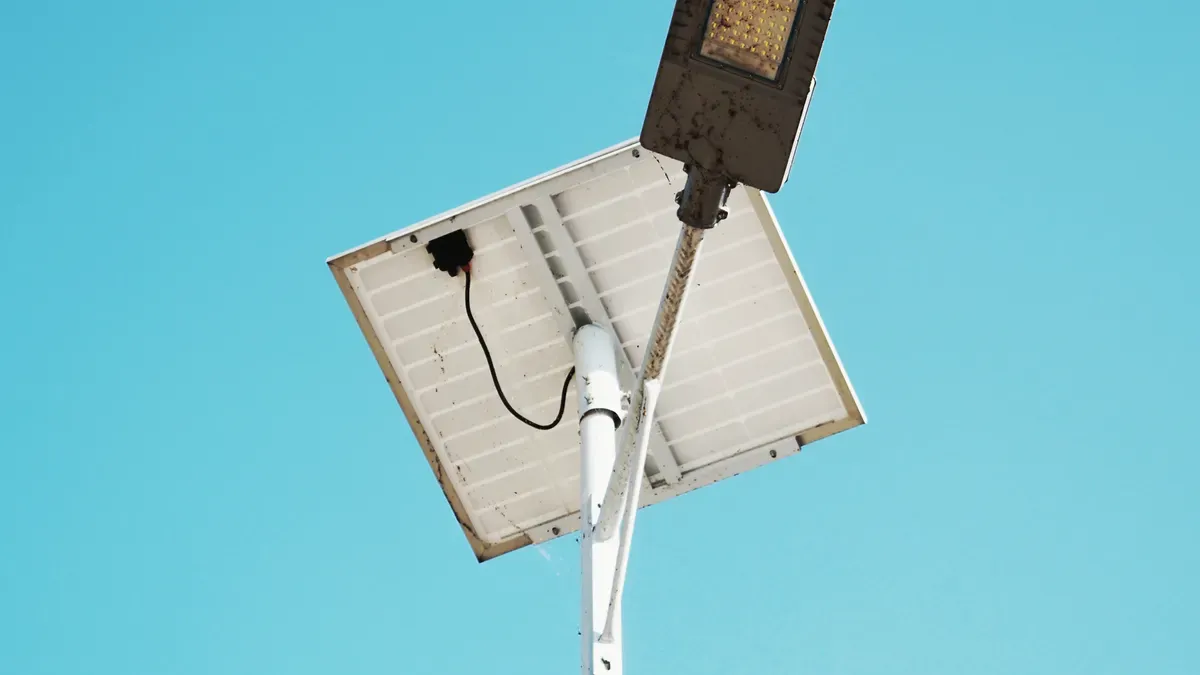
4.1 Solar PV Module Efficiency and Mechanical Mounting Angles
Off-grid applications demand precise solar engineering to guarantee zero system downtime. Your RFQ must require high-efficiency monocrystalline PV modules exceeding 21% solar cell efficiency. Specify solar panels tested under IEC 61215 standards to ensure reliable performance under extreme weather conditions. Bidders must calculate panel wattage using site-specific solar irradiance data rather than generic estimates.
Require vendors to justify the mechanical tilt and orientation of solar panels based on local geographic coordinates. Proper mounting angles maximize daily peak sun hours and prevent dust accumulation. Bidders must also provide wind load calculations for PV brackets. Dynamic wind forces can detach poorly secured panels from the street light pole. For tight urban footprints, request proposals featuring integrated solar street lights to minimize wind drag and streamline installation.
4.2 Battery Sizing, Depth of Discharge, and Energy Management Systems
Energy storage system design determines autonomous operating days during prolonged overcast weather. Your RFQ must mandate smart energy management systems (EMS) with Maximum Power Point Tracking (MPPT) charge controllers. MPPT controllers increase charging efficiency by up to 30% compared to standard PWM units.
Mandate Lithium Iron Phosphate ($\text{LiFePO}_4$) chemistry over traditional lead-acid or gel batteries. $\text{LiFePO}_4$ chemistry offers superior thermal stability and higher energy density.
| Performance Metric | Lead-Acid / Gel Batteries | LiFePO4 Batteries |
|---|---|---|
| Depth of Discharge (DoD) | Restricted to a shallower discharge range to prevent premature degradation and capacity loss. | Supports a significantly deeper usable capacity window when controlled by a BMS. |
| Cycle Life | Experiences a shorter operational lifespan due to rapid aging from nightly deep cycling, high ambient temperatures, and partial charging states. | Provides a substantially longer potential cycle life, maintaining longevity even under continuous daily cycling conditions. |
Require bidders to integrate full Battery Management Systems (BMS). The BMS protects cells against overcharging, deep discharge, and thermal runaway. Finally, mandate automated dimming profiles to stretch battery reserves through critical early morning hours.
Part 5: Quality Assurance, Certifications, and Commissioning
5.1 Mandatory Standards, IP/IK Ratings, and ISO Certifications
You must enforce strict quality standards in your RFQ to prevent premature component failure. Require suppliers to hold ISO 9001 quality management certifications for all manufacturing facilities. Bidders must also provide accredited laboratory test reports for ingress protection and impact resistance.
- Ingress Protection (IP): Mandate a minimum IP66 rating under IEC 60529 standards for optical and electrical driver compartments.
- Impact Resistance (IK): Require IK08 to IK10 mechanical protection ratings to survive vandalism and severe weather conditions.
- Manufacturing Quality: Specify ISO 14001 environmental management and ISO 45001 occupational safety compliance.
5.2 Factory Acceptance Testing (FAT) and Pre-Shipment Inspection
Protect your project timeline by identifying manufacturing defects before equipment leaves the factory floor. Your RFQ must require a formal Factory Acceptance Testing (FAT) protocol for all shipment batches.
[Quality Audit Request] ➔ [Sample Selection & Dimensional Check] ➔ [Electrical / Photometric FAT] ➔ [Pre-Shipment Sign-off]
Bidders must allow your QA representatives or third-party inspectors to review raw materials, structural welding, and surface finishes. Manufacturers must conduct burn-in testing for all LED street lights for at least 24 to 48 continuous hours. Inspect galvanizing thickness on all steel components to ensure full compliance with project specifications before approving final dispatch.
5.3 Field Testing, Photometric Audits, and Handover Protocols
Field verification guarantees that installed hardware performs as calculated during the design stage. Require contractors to conduct physical field audits alongside municipal inspectors prior to project sign-off.
| Audit Phase | Required Verification Activity | Acceptance Benchmark |
|---|---|---|
| Electrical Commissioning | Ground resistance, insulation resistance, and line voltage drop checks | Zero short circuits; grounding within safety limits |
| Photometric Verification | Calibrated lux meter grid measurements across road zones | Matches approved IES simulation within ±5% tolerance |
| Structural Inspection | Vertical plumb alignment, anchor nut torque, and weld visual check | Zero structural tilt; exact bolt torque compliance |
Require full handover packages containing as-built drawings, operations manuals, and warranty sign-offs. This thorough commissioning process guarantees seamless municipal asset transfer and protects long-term operational margins.
Part 6: Commercial Terms, BOQ Structure, and Maintenance
6.1 Commercial Terms and Street Lighting RFQ Pricing Structures
Unclear pricing structures create unexpected budget overruns during execution. You must require a detailed Bill of Quantities (BOQ) in your Street Lighting RFQ. Force bidders to itemize costs across distinct project categories instead of submitting lump-sum figures.
| BOQ Category | Mandatory Cost Breakdown Items | Cost Evaluation Focus |
|---|---|---|
| Luminaire Units | LED fixtures, smart control nodes, optical lenses, internal drivers | Unit price and power efficiency ratio |
| Structural Hardware | Light poles, mounting brackets, anchor bolt kits, base plates | Material grade, coating finish, and structural rating |
| Civil & Electrical | Cable runs, conduit piping, pull boxes, foundation concrete | Material length, trenching depth, and concrete volume |
| Labor & Services | Equipment assembly, field wiring, testing, and commissioning | Hourly labor rates and crew installation capacity |
This transparent structure helps you evaluate vendor proposals on a true apples-to-apples basis.
6.2 Value Engineering, Energy Savings Guarantees, and Lead Times
You should invite bidders to submit value engineering proposals alongside their base bids. Suppliers often suggest alternate component selections that lower material costs without sacrificing photometric performance.
- Energy Savings Guarantees: Require contractors to sign performance guarantees. Link these guarantees directly to calculated power consumption reductions.
- Production Lead Times: Demand binding delivery schedules for every project phase.
When you face tight municipal delivery windows, partner with experienced suppliers like LeapPole. They deliver high-volume orders quickly and can supply a fully certified custom street lighting solution to protect your target completion date.
6.3 Warranty Terms, Spare Parts Kits, and Operations Dispatch Services
Protect your long-term operating margins by defining clear Service Level Agreements (SLAs) in your tender. Require comprehensive system warranties covering luminaires, drivers, structural poles, and smart controllers for at least 5 to 10 years.
Mandatory Spare Parts Provision: Bidders must supply a mandatory 5% spare parts kit with the primary hardware delivery. This kit must include extra LED drivers, control modules, and surge protectors.
Require vendors to maintain rapid local customer support dispatch. Bidders must guarantee fixed response times for critical failures. Set a mandatory 24-hour dispatch rule for total circuit outages and a 48-hour replacement turn-around for single luminaire defects.
Drafting a thorough Street Lighting RFQ eliminates operational risks and shields your project margins against change orders. Precise procurement specifications enforce exact engineering alignment across structural and electrical components.
Partnering with proven manufacturers like LeapPole streamlines your supply chain and guarantees turnkey execution.
Clear performance requirements ultimately lower total lifecycle costs and secure a fast, seamless municipal handover. Reach out to LeapPole today to refine your technical specifications and prepare your next project tender.
FAQ
What project information should an EPC contractor include in a street lighting RFQ?
Provide the project location, road layout, lane widths, functional zones, pole positions, required lighting criteria, environmental conditions, quantities, delivery destination, and construction schedule.
The RFQ should also include available CAD drawings, luminaire and pole schedules, electrical diagrams, soil information, local wind data, applicable standards, and client specifications. Missing information should be identified as an assumption requiring confirmation.
How do you determine the correct pole height and spacing?
Pole height and spacing should be determined through photometric calculations using the actual roadway width, pole arrangement, luminaire optics, outreach, tilt, pavement properties, and required lighting class.
Structural design is a separate calculation. Local wind conditions, luminaire and bracket loads, pole geometry, material strength, and foundation conditions determine whether the proposed pole can support the selected equipment. Do not use photometric spacing calculations as a substitute for structural analysis.
What luminaire information should the RFQ specify?
Define the required lighting performance and operating conditions, including:
- Delivered lumen output
- Nominal system power
- Optical distribution
- Color temperature and color rendering
- IP and IK ratings
- Surge protection
- Driver and control interface
- Mounting arrangement
- Required photometric files and reports
- Warranty and expected service conditions
Avoid specifying only an LED chip or driver brand. Complete luminaire performance, thermal management, optical control, electrical protection, and test documentation are more useful when comparing LED street lights.
Can EPC contractors request custom pole profiles and bracket designs?
Yes. The RFQ can specify custom pole geometry, mounting height, outreach arms, decorative finishes, equipment interfaces, and access-door arrangements.
The supplier should confirm material grade, wall thickness, base plate, anchor bolts, welding, surface treatment, and structural design criteria. Custom street light poles must be evaluated against the complete installed loading and project-specific environmental conditions.
What should the RFQ state about galvanizing and corrosion protection?
Define the required surface treatment standard, coating method, inspection requirements, and any additional finish. For steel poles, clarify whether hot-dip galvanizing must be completed after fabrication and welding.
Coastal, industrial, high-humidity, or chemically aggressive environments may require enhanced corrosion protection. Suppliers should identify the proposed treatment system and provide relevant inspection or coating documentation.
How should foundation components and pole accessories be handled?
State whether the pole price includes the base plate, anchor bolt cage, template, nuts, washers, terminal block, access door, internal wiring, cable entry, and earthing provisions.
List pole accessories and foundation parts separately when different contractors are responsible for product supply and civil installation. This prevents suppliers from making different assumptions about the scope.
How should manufacturers address production and delivery schedules?
Require bidders to submit lead times for drawings, sample approval, material procurement, production, inspection, packing, and delivery. Identify any required hold points for factory inspection or Factory Acceptance Testing.
For phased projects, specify the required batch quantities and delivery sequence. The quotation should state production capacity, shipping assumptions, packing method, Incoterm, delivery destination, and the validity of the proposed schedule.
What documentation should suppliers submit with their quotations?
Depending on the project scope, request:
- Completed technical compliance matrix
- Itemized commercial quotation
- Product datasheets
- IES or LDT photometric files
- Photometric calculations
- Pole drawings
- Structural calculations
- Material and surface-treatment details
- Relevant laboratory reports
- Quality inspection plan
- Warranty statement
- Spare-parts recommendation
- Packing and delivery plan
- List of deviations and exclusions
Documents should correspond to the exact models and configurations offered, not similar reference products.
How can EPC contractors obtain a project-specific quotation from LeapPole?
Submit the RFQ, BOQ, project drawings, roadway dimensions, environmental data, quantities, required standards, delivery destination, and project schedule.
Contact LeapPole for a technical and commercial proposal covering luminaires, poles, structural requirements, accessories, documentation, packing, and phased delivery.


